The key points up front
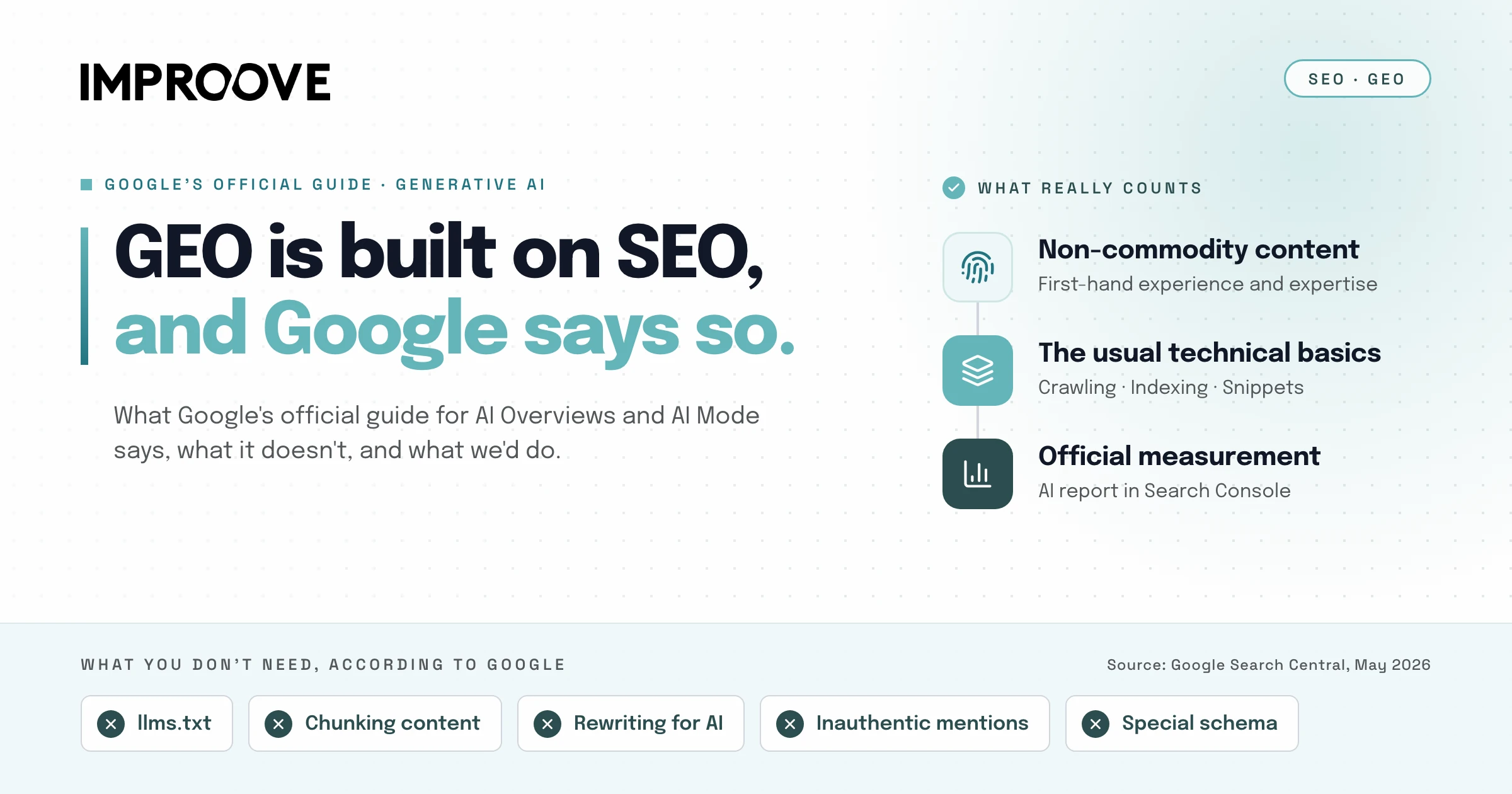
- Google has put it in writing: in its search engine, SEO remains essential for appearing in AI Overviews and AI Mode. There are no special files or markup to add.
- What does go up is the bar for content. Generic content, the kind anyone (or any AI) could write, loses value compared with real experience and expert judgment.
- You can stop investing in llms.txt, chunking your content or chasing artificial mentions, at least as far as Google is concerned: the guide says they do not help.
- Since August 31, 2026, you can measure your visibility in Google's AI features in Search Console. Impressions only, but it is official data and it is yours.
On May 15, 2026, Google published its first official guide to optimizing a website for its generative AI features: Google's Guide to Optimizing for Generative AI Features on Google Search. John Mueller announced it on the Search Central blog, and it has been updated several times since then: the latest English version is dated July 10, 2026.
A lot was written about it at the time, mostly in the form of summaries and sometimes with an easy headline: "Google says GEO doesn't exist." We chose to read it alongside everything Google has published since, because the picture is more complete today: the generative AI report in Search Console and the control for opting your site out are now available worldwide.
A note on how this article is written. According to Google itself, good SEO advice either presents its claims as opinion based on data or experience, or backs them up with Google's official documentation (guidance on third-party SEO tools and advice). So in each section you will find, separately, what Google says, with a link, and our take, under our name.
1. For Google, optimizing for AI is still SEO
What Google says. Its generative AI features, AI Overviews and AI Mode, rely on the same ranking and quality systems as traditional search. To answer queries, they combine two techniques. The first is retrieval-augmented generation (RAG), also known as grounding: the AI pulls relevant, up-to-date pages from Google's index, builds the answer from them and links to them as sources. The second is query fan-out: the model runs several related queries in parallel to complete the answer. Google's example: for "how to fix a lawn full of weeds," the system also searches for the best herbicides, how to get rid of weeds without chemicals and how to keep them from coming back.
The guide explicitly mentions the terms AEO (answer engine optimization) and GEO (generative engine optimization) and settles the debate: from Google Search's perspective, optimizing for generative AI search means optimizing for the search experience, and therefore "it's still SEO." To appear, a page has to be indexed and eligible to be shown with a snippet, with no additional technical requirements (AI features and your website); the only exception is a Search Console setting we cover in section 4.
Our take. Concluding that "GEO is dead" means skimming the guide. What Google says is that, within its search engine, GEO is built on top of SEO. That is the idea behind how we approach GEO at Improove (why SEO and GEO belong together), and now Google has signed off on it.
But it is also worth reading what the guide does not say. It only covers Google Search: AI Overviews, AI Mode and the AI features in Discover. It says nothing about ChatGPT, Perplexity, Copilot or the Gemini app, where each platform has its own rules and picks its sources in its own way. That is why we still talk about GEO: not as a separate discipline or a bag of tricks, but as SEO done right, plus measurement and visibility work in AI assistants.
"Google hasn't killed GEO: it has cleared away the smoke. In its search engine, doing GEO means doing good SEO. What you don't need are the shortcuts."
David Terrón Sánchez, Head of SEO/GEO at Improove
GEO that builds on your SEO
With our AI Search Strategy, we connect your SEO foundation with targeted work on your visibility in ChatGPT, Perplexity, Gemini and Google's AI features, including measurement that shows what works.
Explore AI Search Strategy2. The bar that does go up: goodbye to generic content
What Google says. Of everything the guide recommends, Google highlights one thing above the rest: creating content that users find unique, engaging and helpful is what has the greatest influence on your presence in AI search, "more than any other suggestion in this guide." And it gives the opposite a name: commodity content. "7 tips for first-time home buyers" is commodity content, because it relies on knowledge anyone could offer. "Why we waived the inspection and saved money: a look inside the sewer line" is not, because it comes from an experience no one else can tell in the same way. The guide literally asks you not to simply repeat what others have already said online or "what a generative AI model could easily produce."
It also sets two limits. Creating a page for every search variant in order to manipulate rankings or AI answers violates the scaled content abuse policy. And using AI to create content is allowed, as long as the result complies with Search Essentials and the spam policies (Google Search's guidance on using generative AI content on your website). As Google clarified in May, those policies also apply to its generative answers.
Our take. This is the uncomfortable part of the guide and, for us, the most important one. Many corporate blogs are full of articles an AI could write in thirty seconds without knowing anything about the company. That content is no longer competitive: if your article says the same thing as a hundred others, Google's AI has a hundred other sources to choose from and does not need yours. What it does need is what only you have: your data, your cases, your experts' judgment, what you have learned from getting things wrong.
"The content an AI could write without you is exactly the content Google's AI doesn't need to cite."
David Terrón Sánchez, Head of SEO/GEO at Improove
In practice, that means publishing fewer, deeper pieces, written by people who really know the subject. AI can help with production, but it does not replace experience. That is why at Improove all content, including what we produce with the help of AI, goes through human review before it is published.
3. What you can stop doing (and paying for)
What Google says. The guide devotes an entire section to debunking AI search myths. In short:
AI search myths according to Google
| Tactic | What Google says |
|---|---|
| Creating an llms.txt or other files, tags or Markdown "for AI" | Google Search does not use them: they neither help nor hurt. You can keep them if other services use them. |
| Chunking content into small fragments | Not necessary: its systems understand multiple topics on a single page. There is no ideal length. |
| Rewriting content just for AI or covering every keyword variant | Not necessary: the AI understands synonyms and the meaning behind a search. |
| Seeking inauthentic mentions on other websites | Not as useful as it seems: its systems reward quality content and block spam. |
| Obsessing over structured data (schema) | It is not required for AI, and there is no special markup. It is still useful for rich result eligibility. |
A piece of context that reinforces the last point: since May 7, 2026, Google no longer shows FAQ rich results, a type of markup heavily recommended in many GEO guides (latest documentation updates).
Our take. This section saves you money. A large share of what has been sold as GEO over the past year consisted of exactly these tactics, and now Google says in writing that they add nothing in its search engine. That does not make schema useless: we still recommend it for rich result eligibility, but it is not the key to Google's AI. Mentions are a similar story: authentic ones count, and what helps is that what is said about your brand is consistent everywhere (that is what brand entity management is about).
Our filter for any "AI optimization" proposal is simple: if someone sells you a trick for showing up in Google's AI, ask them for the page in Google's documentation that backs it up.
4. The same technical foundation, with a new switch
What Google says. The technical side holds no surprises: crawlable content, pages that are indexed and eligible to be shown with a snippet, JavaScript that does not block access, a good experience on any device, little duplicate content and semantic HTML that does not have to be perfect, but helps.
What is new is a requirement that did not exist a few months ago: your site has to be included in the Search generative AI control in Search Console (Settings > Search generative AI). It is on by default and, since August 31, 2026, it is available for every website worldwide (Search Console Help). If you opt out, your content stops appearing in AI Overviews, AI Mode and the AI features in Discover, and it is no longer used to ground their answers. Google clarifies that the setting is not used as a ranking signal in the rest of Search and does not affect model training, which is managed separately with Google-Extended.
For local businesses and ecommerce, the guide adds two very specific levers: Merchant Center feeds and your Google Business Profile, which feed both AI answers and the rest of the search results.
Our take. Check today that this switch is set the way you want it. And before you turn it off because of the debate about AI and content, keep in mind two things Google itself says. If you opt out, content from other sites will keep appearing in those features, "and it may be similar to yours." And staying out also prevents you from standing out as a preferred source in AI Mode and AI Overviews for users who have chosen you (preferred sources documentation). Opting out does not make the answer disappear: it only makes your brand disappear from it.
In ecommerce, the product feed is also no longer just a technical Shopping formality: it is content. If it is incomplete or out of date, the AI has fewer reasons to recommend you.
5. Measurement is no longer an excuse
What Google says. For measurement, the guide points to the generative AI performance report in Search Console. Google introduced it on June 3, 2026 for a small group of websites and, since August 31, every site has it. It shows impressions in AI Overviews and AI Mode by page, country, device and date, with a separate report for Discover (report help), and those impressions still count in the standard performance report as well. The guide adds a warning: be wary of third-party tools that promise to improve your rankings or claim to use Google's "internal" metrics, because none of them has access to its systems.
Our take. For the first time, you have official, first-party data on your visibility in Google's AI, and that changes conversations with leadership: the discussion is no longer based on estimates alone. It has one important limitation: it shows impressions, not clicks, so you still cannot calculate an AI CTR. That is why we treat it as the foundation of the dashboard, not the whole dashboard. We export it every month to build a history, we cross-reference it with GA4 to see whether the pages gaining visibility in AI also generate business, and we use third-party tools for what they are: useful estimates for measuring outside Google, in ChatGPT, Perplexity or Copilot. If you want to go further, here are the KPIs we use to measure AI visibility.
Do you know how visible you are in Google's AI?
In a free initial consultation, we look together at where you should start with your AI visibility.
Free initial consultation6. Agents: what is coming and what has not arrived outside the US yet
What Google says. The guide closes with a section, still at an early stage, on AI agents: autonomous systems that carry out tasks on people's behalf, such as booking a table or comparing a product's specifications. Browser agents read your website through screenshots, the page code (the DOM) and the accessibility tree. Google points to the web.dev guide Build agent-friendly websites and to the Universal Commerce Protocol (UCP), an open standard that lets agents complete purchases on the user's behalf.
If you are reading from Europe, there is an important caveat. UCP checkout currently only applies to products in the US, Canada and Australia, and to selected merchants (Merchant Center Help). And Google's Business Agent, which lets customers chat with your brand directly from Search, is rolling out in the US, and customizing it requires a US-based online store (Google Help). AI Overviews and AI Mode, on the other hand, are available across Europe, including Germany, Austria and Spain.
Our take. None of this is urgent today for a European business, but the foundation deserves attention now. Clean HTML, properly labeled forms and an accessible website serve people who browse with a screen reader and, at the same time, the agents that are starting to move around the web. It is one of the few technical investments that pays off twice.
What we would do this week
If we had to turn the guide into a to-do list, this would be it:
- Go to Search Console, under Settings > Search generative AI, and confirm that your site is included.
- Open the generative AI performance report and export the data: that is your baseline.
- Look at which pages collect those impressions and ask yourself whether they are the ones that drive business.
- Review your blog with an uncomfortable question: how many articles could an AI have written without knowing us? Those are the first candidates to improve, merge or remove.
- Freeze any budget line for llms.txt "for Google," chunking content or chasing artificial mentions.
- If you sell online or have physical stores, check that your Merchant Center feed and your Google Business Profile are complete and up to date.
The guide does not change the rules of the game: it puts them in writing. For those who were already getting the fundamentals right, that is good news. For those who were living off shortcuts, it is a warning.
How we help you at Improove
We build GEO on that same foundation. Our AI Search Audit reviews the technical requirements Google sets for appearing in its AI features, including getting your website ready for agents. And our AI Search Strategy adds expert content with human review and measurement that combines Search Console and GA4, both inside and outside Google. If you want to know where to start in your case, let's talk.
