Somewhere out there, an AI is recommending your brand right now. Or it isn't — and a purchase decision gets made anyway. A growing share of digital visibility happens in conversations that no classic tracking captures, with consequences that only show up after a delay. How to shrink this blind spot is what this article is about.
Key takeaways
- GEO needs its own KPIs: Classic metrics like rankings and click-through rates don't work in AI-generated answers. What counts instead is how often your brand gets mentioned, with what Share of Voice, and in what context.
- Prompts instead of keywords: In GEO tracking, you define for yourself which questions you want to track. The quality of your prompt set directly determines how meaningful your data is.
- AI Referral Traffic is only the beginning: Real sessions from AI platforms are measurable, but full conversion attribution is still an open work in progress in 2026.
Why GEO needs different KPIs than SEO
57% of all information-oriented search queries already include AI Overviews (as of June 2025). In Austria, the adoption of AI assistants for search queries is somewhat slower than in the US, but the trend is unmistakable: according to Statcounter, ChatGPT is (still) the most-used AI chatbot here too, followed by Gemini and Perplexity (though Claude is catching up!). Users consume answers directly in the interface, without clicking. That means your brand can play a decisive role in an AI answer without a single session ever landing in your analytics. For Austrian companies, another factor comes into play: German-language prompts still deliver thinner results in many AI models than English ones.
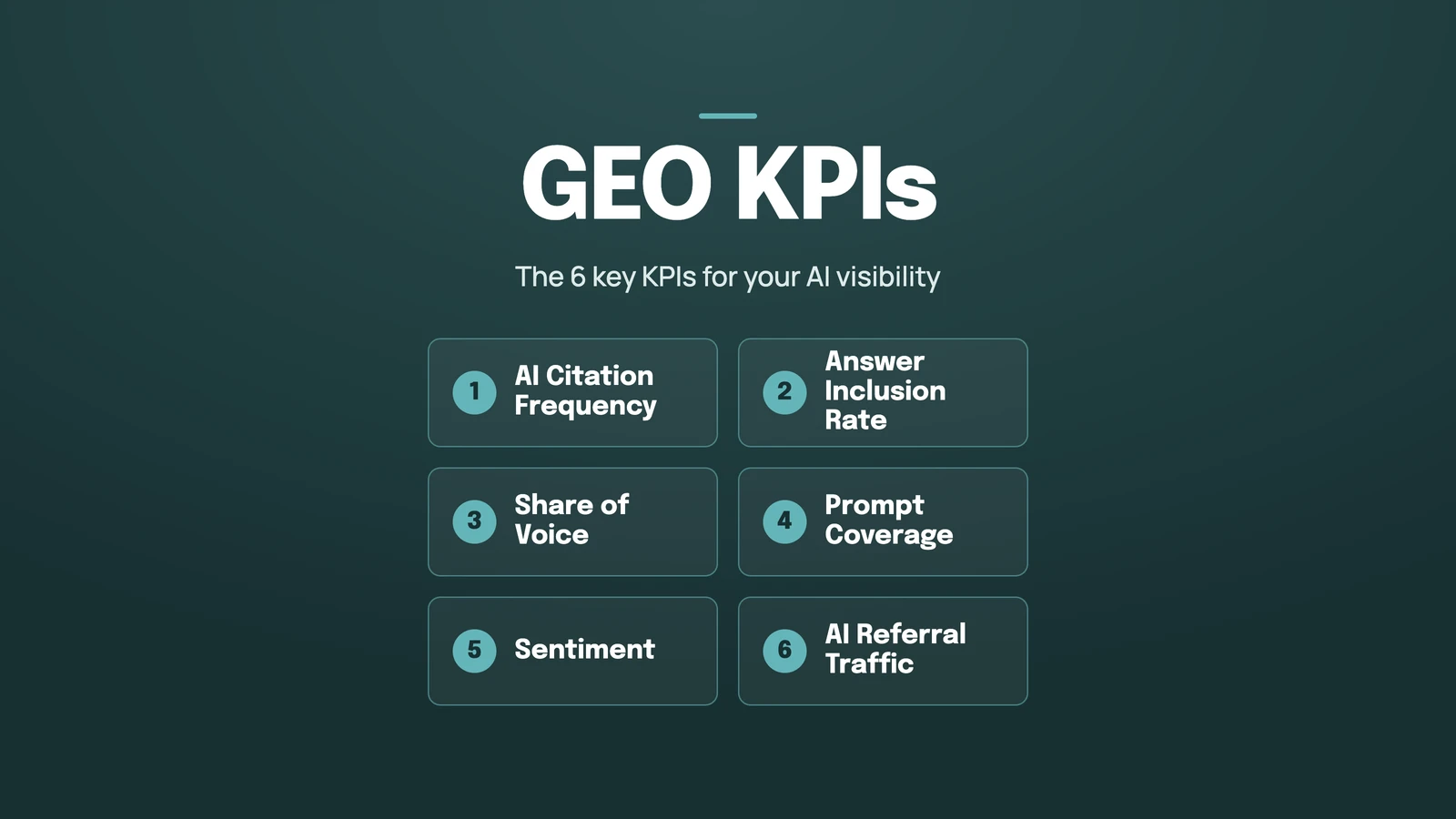
The six most important GEO KPIs
GEO KPIs are not a replacement for SEO metrics; they are a necessary extension. Traffic from AI sources is smaller in volume but stronger in quality: studies show that AI-referenced traffic converts up to 2.3x higher than classic organic traffic. Those who earn citations attract pre-qualified users.
So what are the most important GEO KPIs?
1. AI Citation Frequency
What is AI Citation Frequency? AI Citation Frequency measures how often an AI model directly mentions or cites your brand in its answers, measured across a defined set of prompts. It is the GEO equivalent of the impression in classic SEO and the first indicator of whether your brand is present at all in the context of AI search.
A mention is not the same as a recommendation. Pay attention not only to whether you are mentioned, but also how: as the first recommendation, as one among many, or in an unfavorable comparison. Frequency alone says little; context says everything.
2. Answer Inclusion Rate
What is the Answer Inclusion Rate? The Answer Inclusion Rate indicates the percentage of your tested prompts in which your brand appears in the AI answer. It is calculated as: (number of prompts with a brand mention / total number of tested prompts) × 100. This makes it the most direct measure of your topical reach in AI search.
For context: according to an analysis by Ahrefs, 26% of all brands currently have zero mentions in AI Overviews. Any measurable Answer Inclusion Rate means you are already ahead of a significant portion of the competition. Those who get above 30% are actively present in their category.
3. Share of Voice (SoV) in AI search
What is Share of Voice in AI search? Share of Voice measures how often your brand appears in AI answers relative to direct competitors, when the same prompts are tested across all participants. It is calculated as: (your own citations / total citations of all measured brands) × 100.
AI platforms often name several providers in a single answer. If your competition sits at 60% SoV and you are at 15%, you know where you need to invest. This KPI makes competitive gaps tangible that remain invisible in classic ranking reporting.
4. Prompt Coverage
What is Prompt Coverage? Prompt Coverage analyzes which topical clusters and questions your brand appears for in AI answers — and which it doesn't. It reveals content visibility gaps at the topic level, not just at the keyword level.
Many companies are strong on product-related prompts but invisible when users ask about comparisons, advisory services, or pricing questions. These gaps are direct starting points for content work. Prompt Coverage connects your GEO reporting directly to your content strategy.
5. Sentiment and context quality
What is Sentiment in the GEO context? Sentiment measures the tone and positioning with which AI models describe your brand: as a market leader, as a low-cost alternative, as a specialized solution, or as a generic provider. It is the qualitative dimension behind Citation Frequency.
Studies show that brands consistently positioned by AI systems as category leaders achieve measurably higher conversion rates. Sentiment tracking reveals whether your AI framing matches your actual positioning, and where corrections are needed.
6. AI Referral Traffic
What is AI Referral Traffic? AI Referral Traffic refers to the real website sessions that reach your domain via clickable source links in AI answers — in other words, users who actively clicked on your link after receiving an AI answer. It is the only GEO KPI that is directly measurable in GA4 or other tracking tools like PiwikPRO.
Important limitation: ChatGPT traffic from the mobile app and certain browser integrations passes no referrer and lands as "Direct." The figure in the report is therefore almost always a lower bound of the actual AI traffic. Even so, AI Referral Traffic is currently the most reliable first-party KPI for AI visibility.
How visible is your brand in AI answers?
We analyze your current LLM visibility, develop your prompt set, and show which measures will move your brand forward in ChatGPT, Gemini, and Perplexity.
Free initial consultationPrompts instead of keywords: the foundation of every GEO report
The fundamental methodological difference from classic SEO: in GEO tracking, there is no automated crawling as there is with keyword rankings. You have to define which questions you want to track.
Prompts are the GEO equivalent of keywords, but more contextual and multilayered. A question like "Which agency can help me with AI visibility?" is a prompt. "SEO agency Vienna" is a keyword. The difference lies in the conversational nature and the intent behind it.
Our recommendation from practice: 20 to 50 core prompts that reflect real user intent for your industry. These should cover different funnel stages, from informational questions to clear buying signals. The prompt set should be expanded regularly and adapted to new search patterns.
An important aspect that many underestimate: different AI models deliver different answers to the same prompt. ChatGPT, Gemini, Perplexity, and Claude have different training data, retrieval logic, and sources. Robust GEO reporting therefore tests prompts across multiple platforms.
Tools for GEO tracking: what we use and why
There are already countless tools for GEO tracking. From our work with clients, we've learned that no single tool covers all the relevant KPIs. The following selection is an excerpt from our current stack — we have additional tools in our repertoire that come into play depending on industry, brand, and data needs. What we describe here are the ones we currently work with most often and from which we draw the clearest insights:
- Waikay is our preferred tool for prompt tracking and for a question that stands at the start of every GEO project: what do LLMs actually already know about this brand? This is especially valuable for websites with smaller brand awareness, where AI models often have patchy or outdated knowledge. Understanding what a model takes as its starting point is the foundation for any meaningful optimization.
- Ahrefs is one we like to use for citations and mentions, with a data basis of over 320 million prompts. Its strength lies in breadth. The limitation we know from practice: for brands whose name is an everyday word, distinguishing signal from noise becomes a problem. An AI system that uses the word "drei" in an answer doesn't necessarily mean the brand. For these cases you need either clean context filters or a complementary tool with stronger brand context.
- Google Search Console recently began showing AI Impressions directly in the interface. With this, Google responded to Bing Webmaster Tools, which was the first platform to deliver first-party data on AI visibility. For teams already working in GSC, this is a direct and free entry point into GEO reporting. Bing Webmaster Tools remains interesting as a data source nonetheless, because of the grounding queries: you see not only whether your domain is cited, but through which internal queries Microsoft Copilot came across your content in the first place.
- GA4 is, in our view, currently the most reliable KPI source for AI Referral Traffic, because it measures real user sessions rather than estimating them. For all of our clients, we now build a dedicated GA4 dashboard that segments AI traffic from sources like perplexity.ai, chatgpt.com, gemini.google.com, and copilot.microsoft.com and reports its behavior (bounce rate, time on site, conversions) separately. The catch: anyone who rejects cookies or uses the mobile ChatGPT app does not show up in the referral data.
What GEO tracking still can't do today
Transparency matters here: GEO tracking is not yet mature in 2026. No reliable click-through rate from AI answers, no complete conversion attribution from AI traffic, no consistent benchmarks across industries. Anyone selling you otherwise is overstating things.
GEO reporting works best today as a trend instrument. Your Citation Frequency rises or falls. Your Share of Voice improves relative to competitors. Your AI Referral Traffic grows. These movements are measurable and provide a solid basis for strategic decisions, even if attribution at the individual-click level still has gaps.
GEO reporting that supports decisions
We build monthly GEO and SEO reporting that measures the right KPIs — from Citation Frequency to AI Referral Traffic — and derives concrete actions from them.
Managed SEO & GEOHow Improove can help with GEO KPIs and reporting
At Improove, we start with an analysis of how your brand is perceived in AI answers today: which citations already exist? With what sentiment? Where are the gaps compared to your direct competitors?
On this basis, we develop a tailored prompt set that reflects your actual user intent, and we build monthly GEO reporting that measures KPIs which genuinely contribute to decision-making. We don't treat SEO and GEO as two separate disciplines, but as one system that builds on itself.
FAQ about GEO KPIs
What is the difference between SEO and GEO KPIs?
SEO KPIs measure visibility in classic search engines via rankings, clicks, and traffic. GEO KPIs measure whether and how a brand appears in AI-generated answers. Because AI searches often end without a click, mentions, citations, and Share of Voice are the relevant metrics, not ranking positions.
How do I measure AI Referral Traffic in GA4?
In GA4, under Reports > Acquisition > Traffic Acquisition, you can filter by referral sources such as chatgpt.com, perplexity.ai, gemini.google.com, and copilot.microsoft.com. We recommend a dedicated segment or custom dashboard that reports AI traffic separately and compares its behavior (bounce rate, conversion rate) with other channels.
How many prompts do I need for a meaningful GEO report?
At least 20 prompts to see any trends at all. For statistically robust reporting, we recommend between 20 and 50, distributed across different topic clusters and funnel stages. Too few prompts produce random noise, not a real signal.
Can I compare GEO KPIs across all AI platforms?
No, not directly. ChatGPT, Gemini, Perplexity, and Claude have different retrieval logic and deliver different answers to the same prompt. Meaningful GEO reporting measures each platform separately and only aggregates at the trend level.