AI assistants are changing the way people search – apparently faster in Germany than in the US. Yet ChatGPT, Gemini, Perplexity and other answer engines have not replaced classic search engines so far. They add extra entry points, intermediate steps and decision moments to the research process.
That's what two recent YouGov reports on search behaviour in Germany and the US show. For the German report, 1,005 adults were surveyed between 21 April and 29 May 2026. The sample was weighted to be representative of the German adult population. The full studies are available at YouGov Germany and the YouGov U.S. Report.
Key takeaways
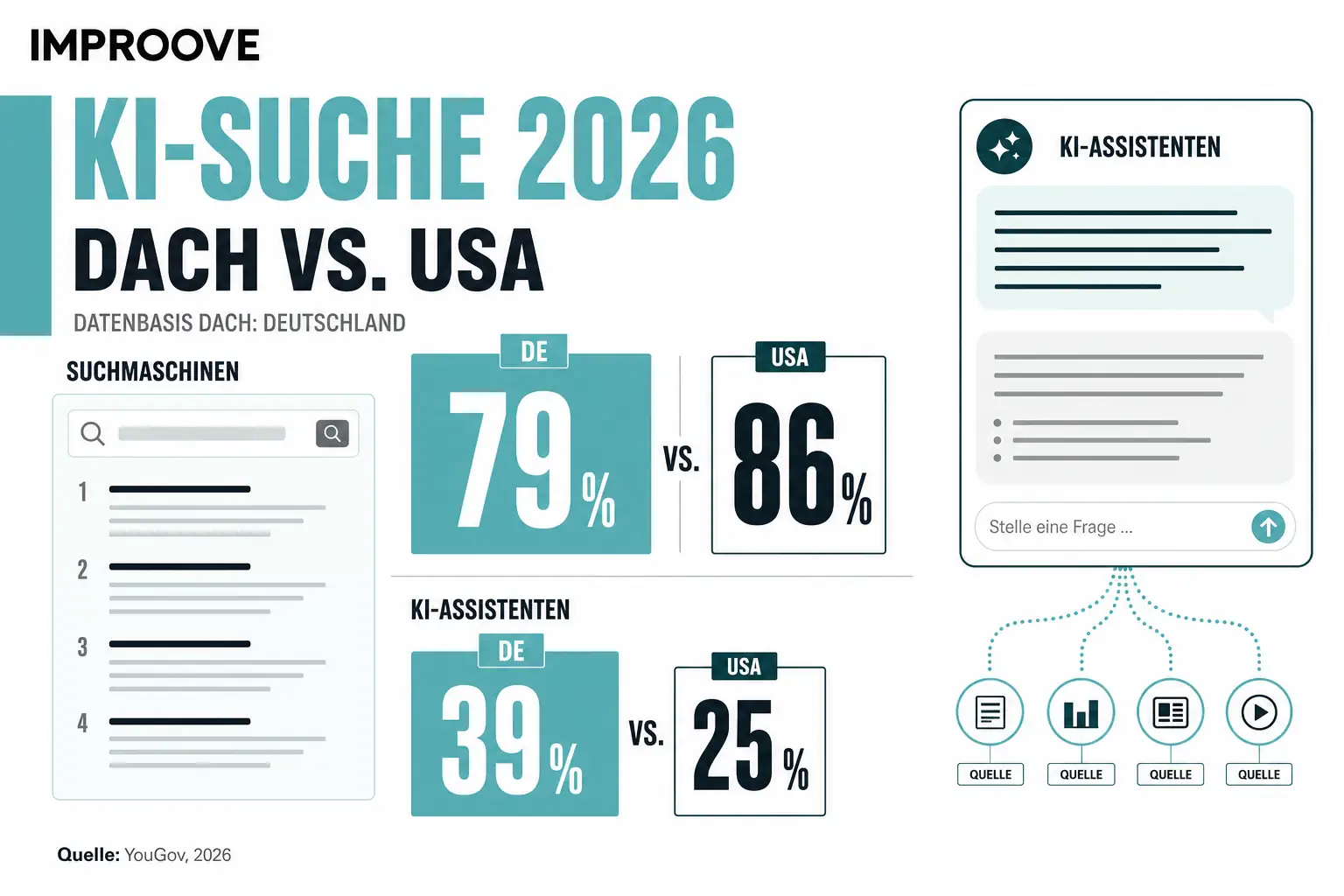
- AI search is already everyday life in Germany. 39 percent use AI assistants, and 30 percent even start specific questions with one – notably more than in the US (25 % and 16 % respectively).
- Search engines remain number one. 79 percent still use classic search engines. It isn't “SEO or GEO” – it's both together.
- Trust and clicks still matter. AI answers rarely end the research completely – credible, citable sources still decide visibility and conversion.
The central takeaway for businesses in DACH isn't “SEO or GEO”. Successful visibility has to combine classic search engines, generative answers, brand perception and verifiable sources.
Germany already searches with AI far more than the US
Classic search engines remain the most important information channel in both markets studied. In Germany, 79 percent of online searchers used a search engine in the past 30 days. In the US, it was 86 percent.
For AI assistants, however, a clear difference emerges:
Usage in the past 30 days
| Channel | Germany | US |
|---|---|---|
| Search engine | 79 % | 86 % |
| AI assistant or chatbot | 39 % | 25 % |
In Germany, AI assistants are already the second most-used information source. They rank ahead of video platforms, news outlets, map services, social networks and marketplaces.
In the US, by contrast, a broader group of channels follows search engines at roughly similar usage levels: video platforms and map services each reach 34 percent, social networks 29 percent, and AI assistants 25 percent.
Germany is therefore ahead of the US market when it comes to AI-assisted search – at least based on self-reported data from this survey.
AI matters most for specific questions
Search engines remain the most common entry point in Germany across every task YouGov studied. But their lead is far smaller for certain information needs than in the US. This is especially clear for specific questions:
Starting point for a specific question
| Starting point | Germany | US |
|---|---|---|
| Search engine | 48 % | 69 % |
| AI assistant | 30 % | 16 % |
Almost one in three online searchers in Germany now begins a specific question with an AI assistant. In the US, only 16 percent do.
The difference is also striking for how-to and problem-solving queries. In Germany, 20 percent of respondents start with AI, compared with nine percent in the US. For product research, it's ten percent in Germany versus four percent in the US.
A clear division of labour is emerging: search engines remain the universal entry point, while AI assistants gain importance especially when users expect a direct, condensed or comparative answer.
For businesses, this means visibility can no longer be planned around individual search terms alone. Content also has to cover the specific questions, comparisons and decision situations people put to AI assistants.
Daily AI search is already widespread in Germany
31 percent of German online searchers start at least one new search query per day with an AI assistant, according to YouGov. In the US, that share is 15 percent.
Daily usage in Germany is especially high among younger age groups:
- 56 percent of Gen Z start at least one AI query every day.
- Among Millennials, it's 42 percent.
- For Gen X, the share is 27 percent.
- Among Baby Boomers and older generations, it's 14 percent.
In Germany, 22 percent say they don't start any search queries with an AI assistant. A further six percent answered “don't know”. In the US, 40 percent report non-use and seven percent “don't know”.
The country comparison within the YouGov study confirms this gap. 68 percent of the German adult population is classified there as AI searchers, versus 48 percent in the US. Switzerland is even higher, at 82 percent.
Austria wasn't covered by this survey. German or Swiss figures shouldn't simply be treated as Austrian usage numbers. Still, for a DACH strategy they send a clear signal: AI search is no longer a distant scenario in German-speaking markets.
Is your brand ready for AI search?
In a free initial consultation, we'll show you how visible you currently are in Google, ChatGPT & co, and which three measures will make the biggest difference.
Book a Free Consultation!Growth is concentrated among people who already use AI
63 percent of German AI searchers say they use AI assistants for information search more often than a year ago. In the US, it's 58 percent.
The outlook is also more dynamic in Germany:
- 43 percent of German AI searchers expect to increase their usage over the coming year.
- In the US, that share is 35 percent.
- Among daily AI searchers, 60 percent in Germany expect further growth, compared with 53 percent in the US.
Among current non-users, reluctance remains high in both markets. In Germany, ten percent expect to search more often with AI in future; 57 percent don't expect to start at all. In the US, only four percent expect increasing usage, while 72 percent don't expect to adopt it.
Growth is therefore driven mainly by more intensive use within the audience already reached – not by a fast conversion of remaining non-users.
What people use AI assistants for
Use cases are similar in Germany and the US. In both markets, getting a direct answer is clearly the top use case.
Use case
| Use case | Germany | US |
|---|---|---|
| Get a direct answer | 64 % | 63 % |
| Summarise content | 37 % | 31 % |
| Verify information | 32 % | 37 % |
| Compare options | 26 % | 29 % |
| Solve problems | 26 % | 24 % |
German AI searchers ask a bit more often for content summaries, while US users turn to AI slightly more often to verify other information.
The underlying need, though, is comparable: people don't just want to find links. They want to condense, organise, compare information and turn it into a usable basis for a concrete decision.
This changes the job content has to do, too. It's no longer enough to simply be findable for a search term. Content has to answer specific questions, explain context, and present reliable information so that both people and machine systems can grasp it clearly.
The AI answer is often not the end of the search
In Germany too, the generated answer is only part of the research journey for many people. According to YouGov, the most common actions after an AI answer are:
Behaviour after the AI answer
| Behaviour | Germany | US |
|---|---|---|
| Click on a provided link | 23 % | 22 % |
| Compare with other apps or sources | 20 % | 16 % |
| Search further on other topics | 8 % | 8 % |
| Next step depends on the topic | 24 % | 32 % |
| Search ends | 21 % | 17 % |
Among daily AI searchers in Germany, 31 percent most often click on the links the AI provides. That makes clicking through to a source more common among heavy users than immediately abandoning the search, which 25 percent report.
These figures put blanket zero-click predictions into perspective. AI search can reduce or shift clicks, but it doesn't eliminate the need for further sources. Especially for complex, expensive or high-risk decisions, users still need evidence, detail and official information.
At the same time, different forms of AI search have to be distinguished. The YouGov survey covers various AI assistants. An independent analysis by the Pew Research Center, by contrast, looked exclusively at Google searches with Google AI Overviews.
In the US sessions Pew observed, users clicked through to a regular search result in eight percent of cases when a Google AI Overview appeared. Without an AI Overview, it was 15 percent. Only one percent of the visits studied resulted in a click directly on a source cited within the overview.
Unlike the YouGov study, this research is based not just on self-reported data but on observed browser behaviour from 900 US adults and 68,879 Google searches in March 2025. The Pew analysis of click behaviour on Google AI Overviews is therefore an important counterweight: sources remain relevant, but being mentioned alone doesn't guarantee a site visit.
For businesses, this creates a dual task:
- Become visible as a relevant source in both classic and generative search systems.
- Offer enough additional value that visibility turns into a qualified visit, a brand effect, or a conversion.
Trust still lags behind usage
Even though people in Germany use AI assistants more often than in the US, trust remains limited.
Trust in information sources
| Source | Germany | US |
|---|---|---|
| Search engines | 72 % | 70 % |
| AI assistants | 36 % | 28 % |
Germany leads the US by eight percentage points in trust in AI answers. Yet classic search engines still enjoy a substantial trust advantage in both markets.
Among people who already search with AI, the gap is much smaller: in Germany, 47 percent trust information from AI assistants, versus 49 percent in the US. Among daily AI searchers in Germany, trust rises to 67 percent.
Usage and trust are therefore closely linked – without the data allowing a causal direction to be inferred.
Transparency and sources can strengthen trust
In Germany, existing AI searchers name three factors above all that could increase their trust in an answer:
- a clear explanation of how the answer was arrived at,
- visible links or source citations,
- information from official sources.
Next come hints about uncertainty, multiple perspectives shown side by side, and a clear label for authentic sources.
Among German non-users, however, 39 percent say none of the queried features would increase their trust. In the US, that share is even higher, at 49 percent.
Transparency features are therefore likely to deepen the trust of existing users first and foremost. Sceptics probably won't be convinced by source links alone.
For SEO and GEO, this is still central. When generative systems assemble answers, content doesn't just compete for positions. It competes to be selected as a credible source and perceived by users as trustworthy.
Visible in AI search?
Visibility no longer comes only from classic rankings, but also from entities, brand signals, content architecture and mentions in AI answers. We build the strategic foundation for Generative Engine Optimization.
Explore AI Search StrategyPrivacy sets limits on personalisation
The Germany report also shows that personalisation isn't automatically seen as added value.
Among German AI searchers, 26 percent are comfortable with personalised answers if they can easily control or turn them off. 25 percent prefer less personalised answers in exchange for less personal data being used.
Among non-users, 40 percent fundamentally disagree with their data being used for personalised answers. In the US, that share is even higher, at 68 percent.
For businesses in DACH, this means: personalisation shouldn't be treated as a silent default. Transparency, control and traceable data use are becoming part of both user experience and trust.
What the data means for SEO and GEO
Seven concrete action areas can be drawn from the results.
1. SEO remains the technical foundation
Google explicitly states that established SEO fundamentals also apply to Google AI Overviews and AI Mode. For a page to appear there as a supporting source, it has to be indexed and generally eligible for a regular search result with a snippet.
Technical crawlability, internal linking, understandable page structures and content actually present in the HTML therefore remain relevant. Google names no special markup that guarantees inclusion in Google AI Overviews. The official Google documentation on AI features and your website speaks against supposed GEO shortcuts.
2. Give specific answers early and clearly
30 percent of German online searchers already start a specific question with an AI assistant. Content shouldn't hide its most important statement behind long introductions.
A sensible structure starts with a clear answer and then adds context, caveats, evidence and detail. This improves the user experience and makes it easier for machine systems to identify a document's central claim.
3. Back up claims with verifiable evidence
Original data, transparent methods, source links, definitions and concrete examples make content more credible.
The 2024 KDD conference paper “GEO: Generative Engine Optimization” examined how changes to content can affect its visibility in generative answers. In the experimental setup used, sources, statistics and citations, among other things, improved measured visibility. The authors report gains of up to 40 percent.
That figure isn't a general promise of success. It comes from a controlled benchmark and doesn't guarantee comparable results in current live systems. Still, the study supports the fundamental importance of well-evidenced, information-rich content.
4. Build proprietary data and expertise
Generic summaries are easy to replace. Harder to replace are original research, hands-on experience, case studies, benchmarks and clearly attributable expert opinions.
Content like this gives search systems and users a reason to name, visit, or associate a particular source with a brand.
5. Build consistent brand and entity signals
Generative systems need to recognise who is making a claim, what expertise stands behind it, and how companies, people, services and topics relate to one another.
This includes consistent company information, credible authors, understandable service pages, structured data, external mentions and a clear thematic content architecture.
6. Measure AI visibility systematically
Rankings and organic clicks remain relevant, but they're no longer sufficient as the only metrics. An AI Search Audit can additionally examine whether a brand appears in relevant AI answers, how it's positioned there, which competitors are mentioned more often, and which sources the systems rely on.
Businesses should track:
- whether their brand appears in relevant AI answers,
- how it's described and positioned,
- which competitors are named,
- which own or external sources are cited,
- which topics are missing brand mentions,
- which landing pages generate qualified visits and conversions.
In June 2026, Google also began testing dedicated Search Console reports for a subset of websites on visibility in generative search features. The new reports are set to show impressions, displayed URLs, countries, devices and trends over time, among other things.
The announcement of generative search feature reports in Google Search Console shows: AI visibility is evolving from an abstract observation into a measurement field in its own right.
7. DACH is not a single, uniform search market
The report provides solid detailed data for Germany and some international comparison figures for Switzerland, but no data for Austria. Even within Germany, generations and usage intensity differ noticeably.
A DACH strategy shouldn't therefore be built purely on general market studies. It needs its own data:
- relevant German-language prompts and search queries,
- differences between Germany, Austria and Switzerland,
- actual customer journeys,
- brand and competitor mentions in AI answers,
- sources and citations used,
- conversion and revenue signals.
GEO shouldn't rest on a single international percentage, but on the concrete information behaviour of the specific market and target audience.
SEO or GEO? The data points to interplay
The results argue neither for the end of classic search engines nor for treating AI search as a niche topic.
Germany is a particularly good example of this: search engines remain the leading information channel at 79 percent. At the same time, 39 percent already use AI assistants, and 30 percent start specific questions directly with AI.
People move between search engines, AI answers, official websites, platforms and other sources. They're not just looking for information, but also for certainty:
- Is the answer correct?
- Who is behind the claim?
- Can I verify the information?
- Which source provides additional detail?
- Is the answer enough for my decision?
Successful search strategies therefore have to combine several goals:
- technical discoverability,
- strong classic rankings,
- understandable, citable content,
- clear brand and expertise signals,
- presence in relevant external sources,
- measurement of AI visibility and business impact.
SEO continues to provide the foundation. GEO widens the view to how brands and content are selected, described and recommended in generative answers.
Connecting these action areas shouldn't consist of isolated GEO measures. A solid AI Search Strategy combines classic SEO fundamentals with content architecture, entity building, brand signals and a prioritised implementation plan. That turns isolated visibility into a systematic approach for both classic and generative search.
The decisive question, then, isn't whether AI replaces Google. It's this: is your brand visible and trustworthy enough along the entire new search and information journey to be found, named and chosen?
Sources and methodological notes
Primary sources are the YouGov reports “Searching for answers: How AI is changing online discovery in 2026” for Germany and the US.
The underlying multi-country survey was conducted online from 21 April to 29 May 2026. 1,005 adults were surveyed in Germany and 1,494 in the US. The samples were weighted for the respective adult population.
The research is based on self-reported data. It doesn't measure actual search or click behaviour. Small differences shouldn't be over-interpreted. The German results can serve as orientation for the DACH region but don't replace dedicated data for Austria and Switzerland.
Additionally used:
- Pew Research Center: click behaviour on Google AI Overviews
- Google Search Central: AI Features and Your Website
- Google Search Central: generative search feature reports in Search Console
- Aggarwal et al.: GEO – Generative Engine Optimization, KDD 2024