"SEO is dead, AI is here." You'll hear that line at every second conference table in 2026. It's catchy – and wrong. The truth is less comfortable and considerably more important for businesses: classic search and AI search exist side by side, they are only shifting the weights. Treating it as an either-or means optimizing against reality.
Austria in particular deserves a closer look. Plenty of figures circulate about the German and US markets, but the Austrian data is thin – and that is exactly what leads to false conclusions. We have gathered the available 2026 data, put it in honest context and worked out what it means for your website strategy.
AI has arrived in Austria, and faster than many assume
The first reflex of many decision-makers is: "AI search is a niche topic, our customers google like everyone else." The usage data says otherwise.
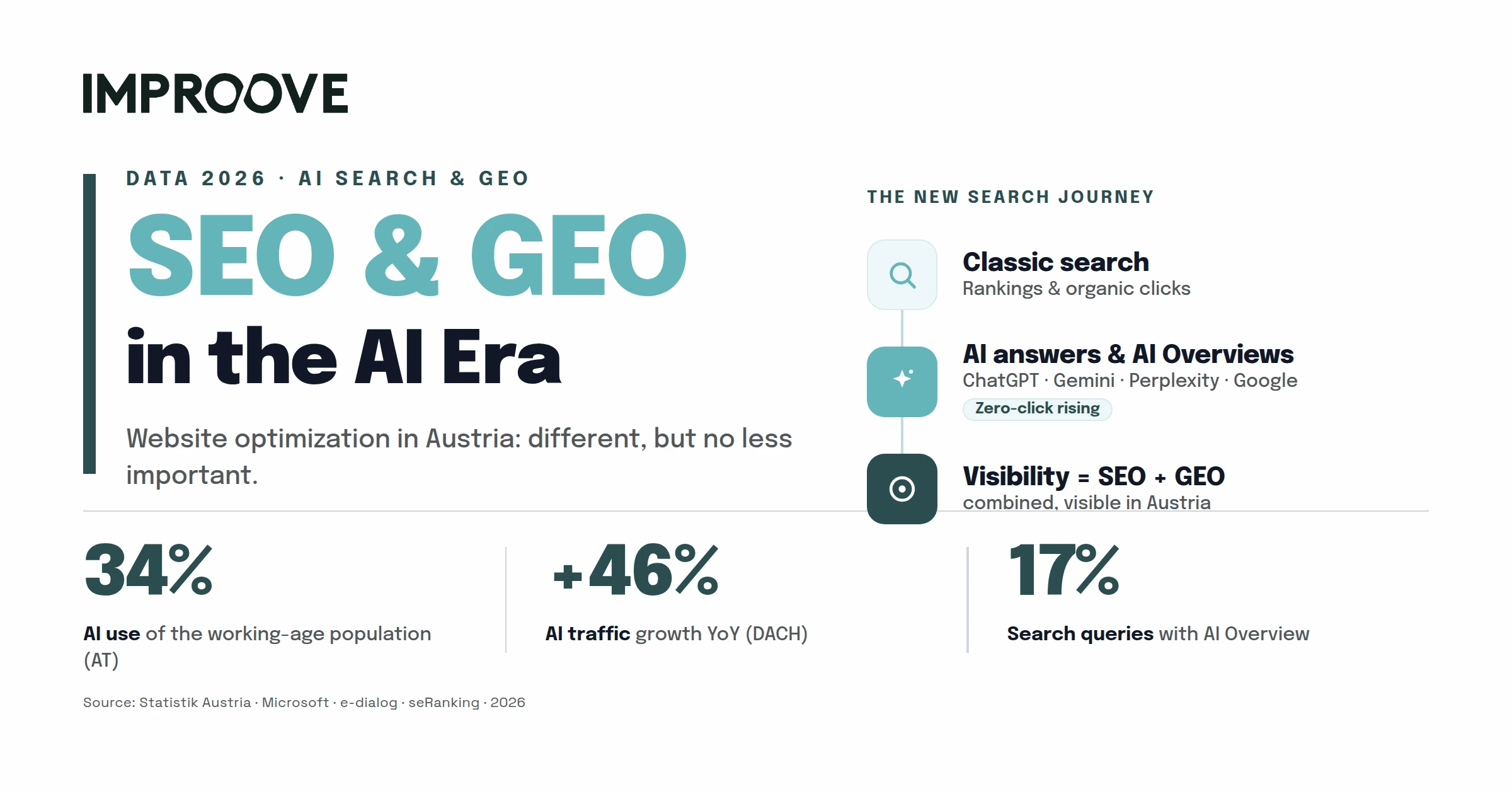
According to Microsoft's AI Diffusion Report (Q1 2026), 34.1% of working-age people (15–64) in Austria use AI tools – well above the global average of 17.8% and trending upwards (Q4 2025: 31.4%). This matches the official figures from Statistics Austria: 31% of the population (16–74) have already used generative AI such as ChatGPT, 28% within the past three months. Among 16- to 24-year-olds the figure is 57.4%, and among school and university students it reaches 75.6%. That is the generation which will become your customers and decision-makers over the next few years.
For comparison: in the YouGov survey we analysed in our article on AI search in German, 39% of Germans said they use AI assistants, more than in the US (25%). Austria was not surveyed separately there, but it clearly ranks among Europe's leaders in AI adoption. So the demand side is in place. The real question is how much of it reaches your websites.
But how much website traffic does AI actually deliver?
This is where the part many agencies are reluctant to say out loud begins: directly measurable traffic from AI platforms is still small. It is growing fast, but it is small.
The seRanking study (January–April 2026, more than 100,000 websites) puts AI referral traffic in the DACH region at 0.38% of total website traffic, up from 0.26% the year before – a year-on-year increase of 46%. The lion's share goes to ChatGPT (~65%), followed by Gemini (~16%) and Perplexity (~15%). A second, independent analysis by e-dialog (1.2 billion sessions across 74 DACH websites) arrives at an AI referral share below 1%, which nevertheless tripled in the first half of 2026. The direction is unambiguous, the level still low.
To stay honest: there is no clean "Austria-only" figure. Depending on methodology and measurement date, the values range from around 0.4% (pure referral) to roughly 2.1% in an earlier e-dialog analysis that broke out Austria. Anyone quoting a precise percentage for your own market is selling an estimate as a certainty. Only one thing is reliable: your own figure from GA4 and Search Console.
Even so, the conclusion is not "ignore AI because the number is small". Visible referral traffic is only the tip of the iceberg. The real effect of AI search shows up elsewhere – and there it has long been in double digits.
How visible are you in AI search, really?
Market averages help you get your bearings, not make decisions. The AI Search Audit measures, on the basis of your own data, how often you are cited in ChatGPT, Gemini and Perplexity, where AI Overviews are costing you clicks and which measures will take effect first.
Explore the AI Search AuditThe bigger lever is invisible: zero-click and AI Overviews
AI changes traffic primarily not by sending new visitors, but by intercepting existing traffic before it reaches your site. Google's AI Overviews answer the question directly in the search results. The click through to the website never happens.
The order of magnitude: AI Overviews already appear for around 17% of keywords, and where they are shown, the click-through rate drops by 20 to 40%. Organic traffic in the DACH region fell by more than 20% in the second quarter of 2026. At 64.6%, organic search remains the most important channel – but it is losing ground fastest.
And here comes the point that matters for Austria: the decline does not hit all markets equally. In the data, Austria proves considerably more resilient – with a traffic loss of around −8% compared with −19% in Germany. The reason, according to e-dialog: features such as AI Overviews are rolled out and trained more slowly in smaller markets.
That is not an all-clear, it is a window of opportunity. Austrian companies currently have a head start of several months in which they can build their visibility for AI search before the full zero-click effect takes hold. That window narrows with every rollout step Google takes.
What this means: SEO and GEO are not an either-or
Put the three data points together – high AI adoption, small but fast-growing referral traffic, mounting zero-click pressure in a still-resilient Austrian market – and a clear strategic conclusion emerges: website optimization in the AI era has not become less important. It has become different. And it only works when SEO and GEO are treated as one system rather than as competing disciplines.
In concrete terms:
- Technical SEO remains mandatory. What isn't crawled and indexed cleanly appears neither in Google nor in AI answers. GEO builds on that foundation, it does not replace it.
- Content has to answer the question directly. LLMs cite sources based on answer quality, not domain age. Answer-first structures, clear definitions and evidenced statements increase your chances of being cited.
- Entity and brand signals are becoming AI's ranking factor. Consistent mentions, structured data and reputation determine whether a model picks you as a trustworthy source.
- Measurement has to cover both worlds. Classic rankings and clicks alone fall short. AI visibility needs its own KPIs, such as citation frequency, answer inclusion rate and share of voice.
- The advantage lies in timing. As long as the Austrian market remains more resilient, now is the cheapest moment to build GEO – not once traffic is visibly collapsing.
Use the window while it is still open
Austria is still more resilient than Germany – and that head start is finite. In a free initial consultation we'll show you where your website stands in Google and in AI search, and which three steps will extend your lead.
Book a Free Consultation!The honest first step: measure your own numbers
The most important insight from this data is also the most practical: do not rely on aggregated market figures to justify your strategy. The AI traffic share of a law firm in Vienna looks nothing like that of an e-commerce shop, and no DACH average captures that.
The starting point is unspectacular and sits inside your own systems: segment referrals from ChatGPT, Perplexity, Gemini and co. in GA4, watch how impressions and click-through rate develop in Google Search Console wherever AI Overviews appear, and set both against your AI visibility. If you want a structured way in, an AI Search Audit provides the right framework. Because only your own data turns a gut feeling into a strategy.