
We were thrilled to be part of LSZ Future of Marketing once again, this time the “AI Edition” in Linz. On October 7, we had the chance to run a workshop there to clear up the most persistent fake news and myths about GEO. The workshop was held in German. Everyone could join in with a round of GEO Bingo, followed by a lively Q&A with the audience. Here we sum up the key points, both for everyone who was there and for everyone who didn't make it to Linz.
The key points up front
- GEO doesn't replace SEO, it builds on it. What crawlers can't read, no AI can cite.
- Every myth ends in a budget decision. Usually money gets invested in the wrong place, cut in the wrong place, or pulled too early.
- Five principles matter: foundation, maintenance, topic focus, mentions and substance. That's work over months, not weeks.
GEO in three minutes
At the start of the workshop, we spent three minutes explaining what GEO actually is, so everyone was on the same page. Someone asks ChatGPT, Perplexity or Google, not for a link but for an answer. The system searches for relevant passages, evaluates them and builds an answer from them. Some brands show up in that answer, with their name and a source, others don't. That's no coincidence. It's the result of structure, substance and external signals. GEO means making sure your brand appears in that answer.
Warm-up: Is Google dead?
We kicked off the workshop with a warm-up question: Is Google's market share in Austria above 90 percent? No. In September 2026 it was 80.88 percent across all devices (StatCounter). Worldwide, though, Google still holds 89.9 percent. On top of that, YouTube, one of the largest search platforms in the world, also belongs to Google, and among AI systems Gemini is currently growing the fastest, with more than 950 million monthly active users (as of July 2026). So Google isn't dead, as many claim. The company has simply broadened its reach.
Myth 1: “SEO is dead, GEO is replacing it.”
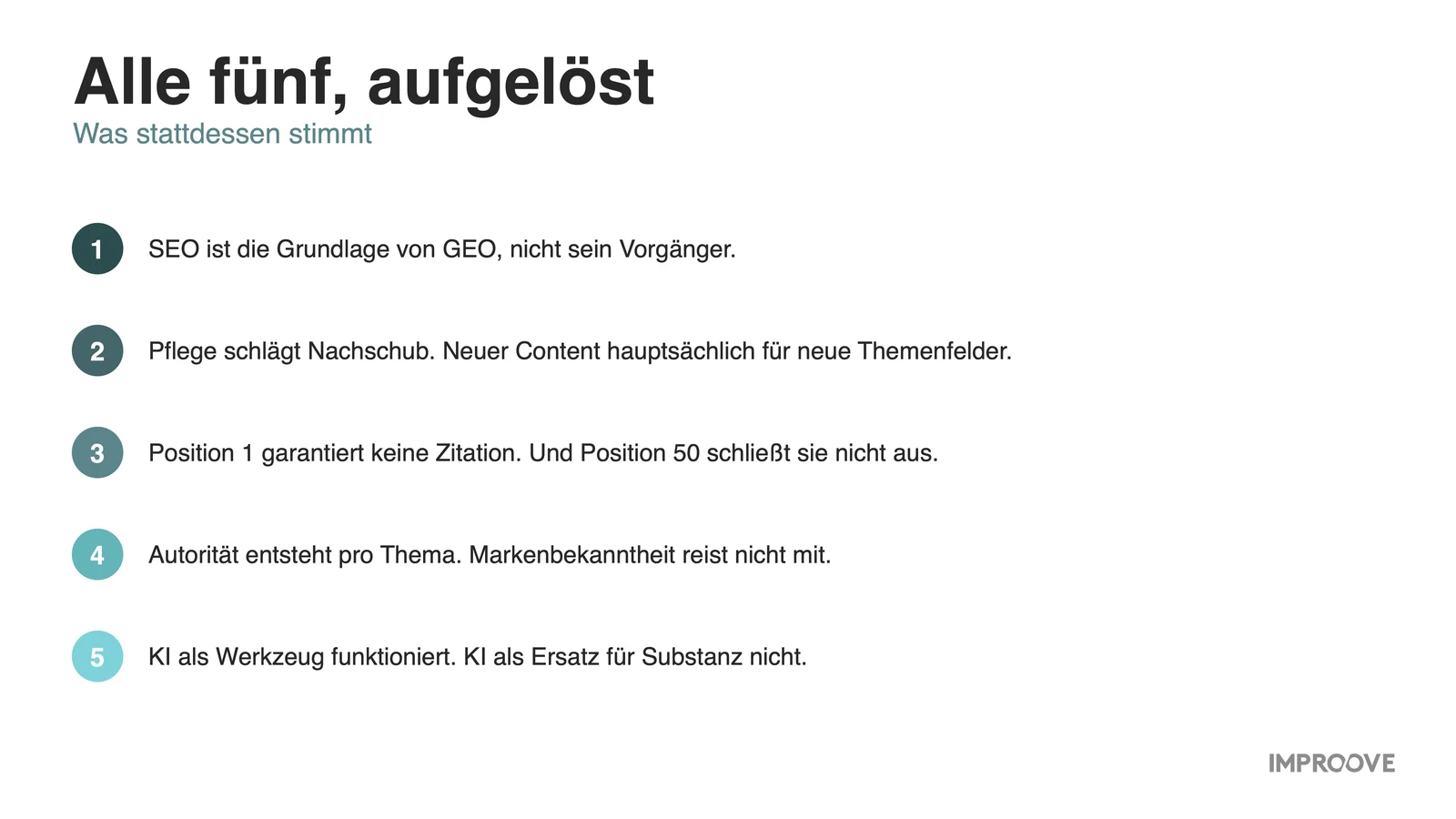
GEO stands on the foundation of SEO. No system can cite something it can't find. Crawlability, indexing and technical basics are SEO and will stay SEO. Google's own AI features, AI Overviews and AI Mode, are also built on the Google index. And much of what makes content more citable is classic on-page SEO: clear headings, precise answer paragraphs, internal linking, topic clusters and clean entities.
What this myth costs: It's the perfect argument for cutting technical SEO budgets. That removes exactly the foundation you just approved GEO budget for.
Myth 2: “More content means more AI visibility.”
Maintenance beats volume. According to Seer Interactive (July 2026, 7,683 cited pages in ChatGPT, Gemini and Perplexity), 75 percent of cited pages had been updated in the past year, but only 42 percent had been published in the past year. More than a quarter are older than two years and have only been maintained since then. A new topic area absolutely needs new content. What doesn't help is doubling the ground you already cover. Our article on content clusters shows how to approach this in a structured way.
What this myth costs: Editorial budget goes into production instead of maintenance, and meanwhile the very content that actually gets cited goes stale.
Myth 3: “We rank number 1, so the AI will cite us too.”
Ranking and citation are drifting apart. A query gets broken down into many sub-questions, and whoever answers a sub-question best gets cited. According to Ahrefs (February 2026, 863,000 keywords), around 38 percent of pages cited in AI Overviews rank in the top 10. Another 31 percent sit in positions 11 to 100, and the remaining 31 percent don't appear in the first 100 results at all. So position 1 is no free pass, and the lack of a top ranking doesn't rule you out either.
What this myth costs: It stops people from measuring at all. If you treat your ranking report as proof, you won't notice that you no longer appear in AI answers. Our article on GEO KPIs explains how to measure it.
Myth 4: “We're a well-known brand, the AI knows us.”
Authority is topical, not global. AI systems know topical connections, not brand fame. A brand that has been publishing about a topic for years gets cited for that topic. If it launches a new product with just one landing page, no topical context and no external mentions, the AI doesn't know it there. Brand awareness doesn't travel with you, authority has to be built anew for each topic. Read more in our article on brand entity management.
What this myth costs: New product lines launch invisible, and nobody understands why, because the brand is strong after all.
Myth 5: “We'll generate the content with AI, and then it scales.”
AI as a tool, yes. As a replacement, no. The difference isn't AI versus human, it's whether your own data comes into play: aggregated project and customer data, your own tests, case studies, original quotes. Without them, there's no reason to cite you rather than ten other pages summarizing the same thing. Then there's the risk: studies show that, depending on the model and the task, AI models invent or misquote a considerable share of their sources when nobody checks. Visible accountability, meaning a real author attribution, is a trust signal, and an editorial team prevents a wrong number from being cited alongside your brand name.
What this myth costs: Lots of interchangeable pages that nobody cites, plus the editorial time you thought you were saving. The savings shift costs, they don't reduce them.
How visible is your brand in AI search?
In our AI Search Audit, we check your visibility in ChatGPT, Perplexity, Gemini, Copilot and AI Overviews, with a benchmark against your competitors and a prioritized list of actions.
Go to the AI Search AuditGEO Bingo: the classics that didn't make the top 5
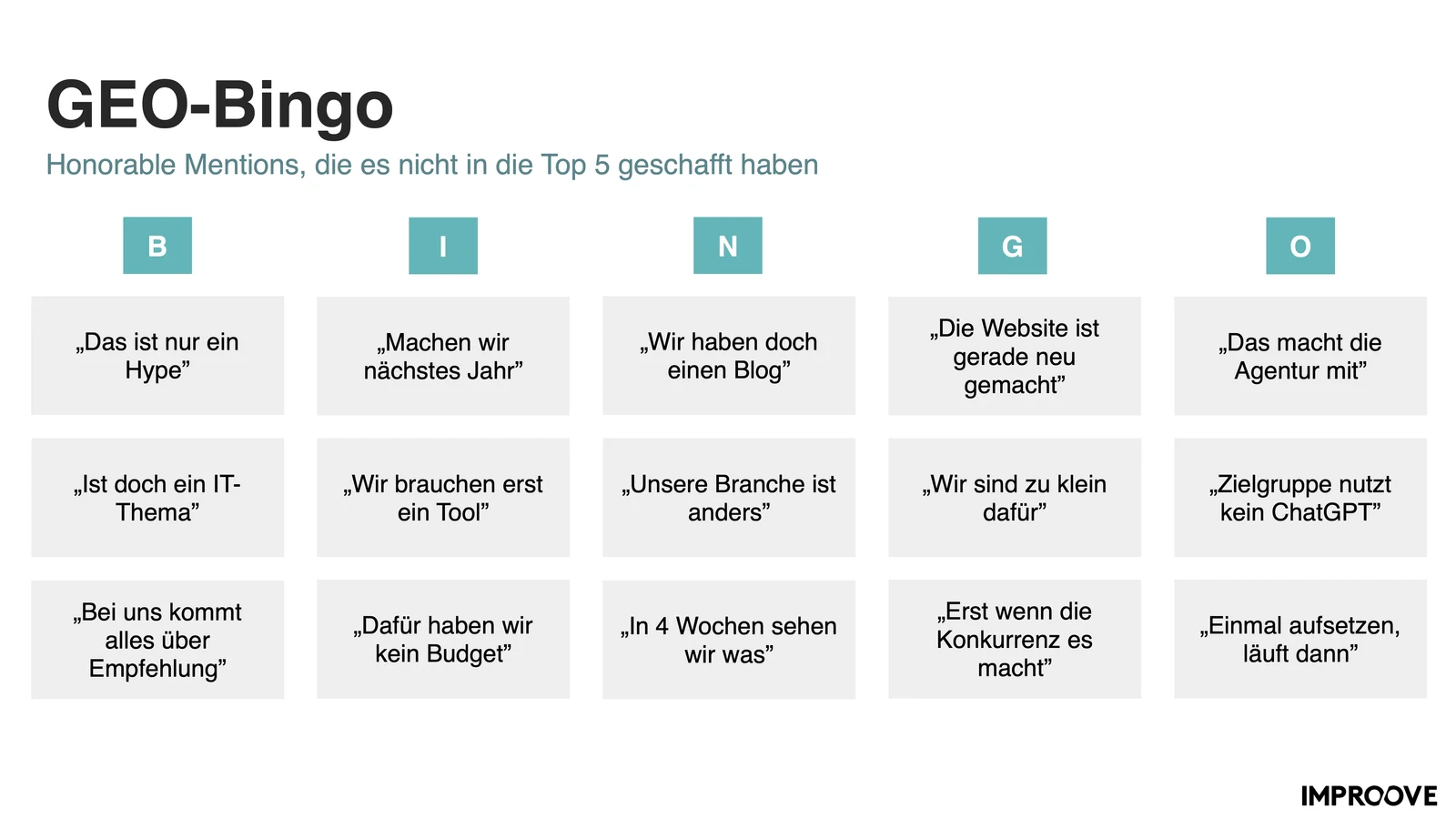
Five myths weren't enough for us, because we hear many more sentences like these in client conversations. That's why the workshop included a round of GEO Bingo with the “honorable mentions”, the classics that just missed our top 5. Everyone marked the ones they had already heard in their own company. How many squares would you get?
What these myths cost
Every one of these sentences ends in a budget decision. We see three patterns again and again:
- Invested in the wrong place: Content budget goes into production instead of maintenance. Existing content goes stale, and the impact never comes.
- Cut in the wrong place: Technical SEO gets dropped because GEO is seen as a replacement. That removes the very foundation you're currently paying for.
- Pulled too early: After six weeks nothing shows, so the project gets ended. Realistically, it takes three to six months before a pattern becomes visible.
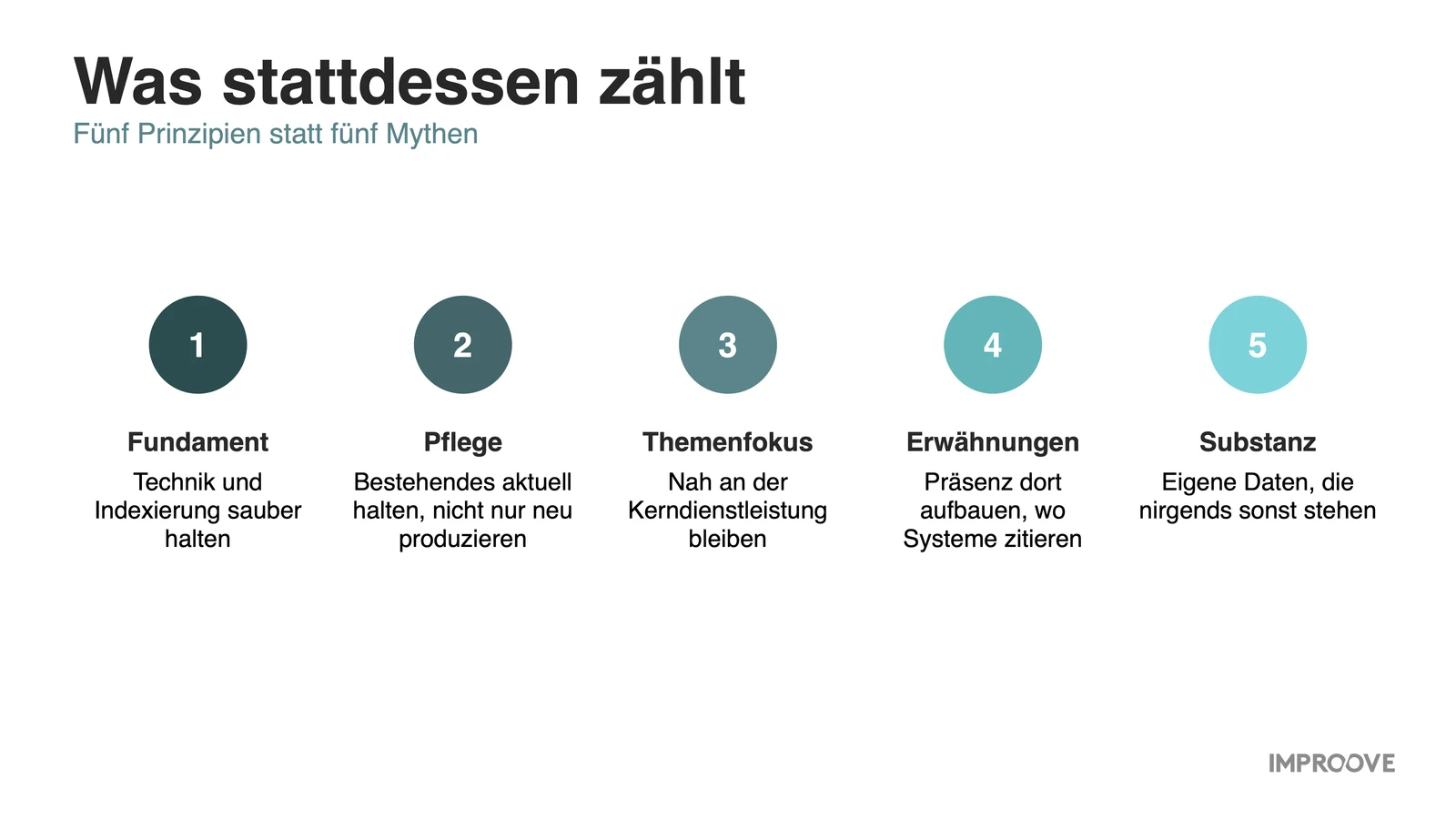
What matters instead: five principles
- Foundation: Keep your tech and indexing clean.
- Maintenance: Keep existing content up to date, don't just produce new content. Check which of your pages get cited and how long ago they were last updated.
- Topic focus: Stay close to your core service.
- Mentions: Build a presence where the systems cite from. That's partly PR work, not SEO work.
- Substance: Your own data that can't be found anywhere else. If you're the only source for a number, you'll be cited for that number.
Bring GEO know-how straight into your team
In the AI Editorial Workshop, you practice maintenance, topic focus and citable content using your own topic.
More about the workshopFrequently asked questions about GEO myths
Has GEO made SEO obsolete?
No. AI systems can only cite what they can crawl and index. GEO builds on SEO, it doesn't replace it.
How long does it take for GEO measures to work?
Realistically three to six months before a pattern becomes visible in AI answers. Citations fluctuate a lot, so individual measurements say little.
How important will PR become for GEO?
Very important, because AI systems don't rely only on your own website. They check whether your brand is also mentioned in connection with a topic in trade media, industry directories, comparison sites or forums. In an Ahrefs analysis of 75,000 brands, these brand mentions were much more strongly linked to AI visibility than the sheer number of backlinks. That's why part of GEO work is classic PR: being present where your target audience and the models do their research.
Do small businesses even stand a chance with GEO?
Yes. Whoever best answers a specific sub-question gets cited, not whoever is biggest. A third of citations in AI Overviews come from pages outside the top 100.
How Improove helps with GEO
If you first want to know where you stand, start with the AI Search Audit: visibility in the most important AI systems, a benchmark against your competitors and a prioritized list of actions. If you want to get going right away, the AI Editorial Workshop is the right fit. Both are part of our SEO/GEO management. You'll find more answers in our big SEO & GEO FAQ.