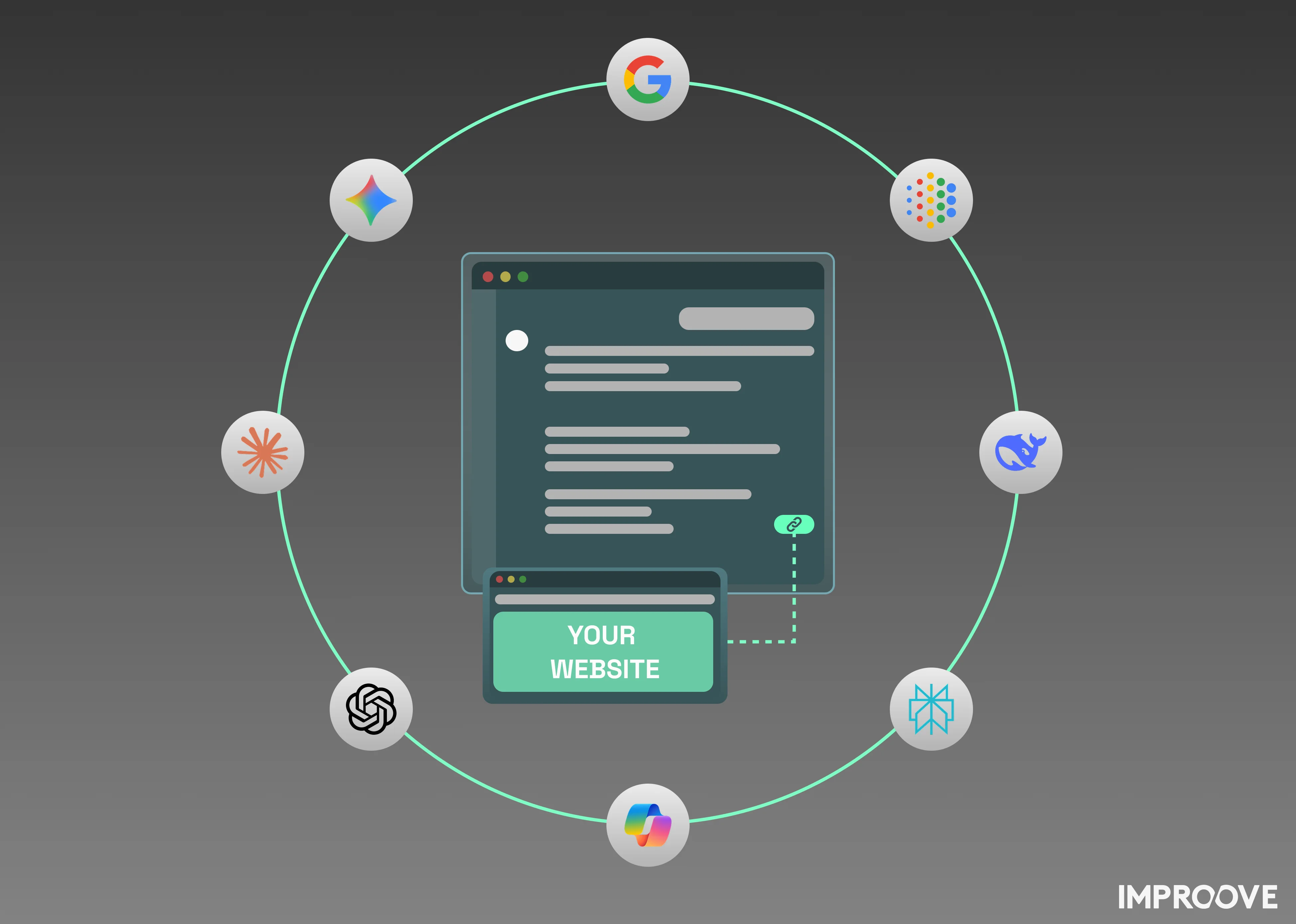
The Most Important Points Upfront:
- LLMs select sources by answer quality: whoever answers the question clearly and correctly has better chances of being cited — regardless of domain age or backlinks.
- Answer-first structure is non-negotiable: LLMs scan the beginning of every content section to find solutions immediately.
- You're still writing for people. Google says you don't need to write in a special way for generative AI search: its systems understand synonyms and intent. Clear, well-organised content serves readers and AI answers alike.
- Being cited once has a compound interest effect: LLM training data increasingly contains synthetic content. Today's citations can become tomorrow's training data.
How LLMs Decide What to Cite
This is what happens when an LLM makes a citation decision:
Step 1: Query Fan-Out
The system breaks down 'Best CRM for small teams' into sub-questions: What is a CRM? What defines a small team? Which criteria matter for this target audience?
Step 2: Document Retrieval
Here the process diverges: in AI search, a number of documents (retrieval) are fetched from live sources. In closed mode, this external retrieval is skipped — the model accesses its internal training knowledge directly.
Step 3: Relevance Scoring
Each document is evaluated by:
- Semantic relevance: Does it answer the sub-question directly?
- Information efficiency: Is the answer right at the beginning or buried deep in the content?
- Factual consistency: Does it contradict other high-quality sources?
Step 4: Citation Selection
The LLM generates the answer and decides on attribution. The selection follows clear priorities:
- Directness: Whoever makes the answer most precisely leads the field.
- Credibility signals: Explicit evidence, current data, and verified author profiles increase the chance.
- Authority & familiarity: With identical statements, the LLM doesn't cite randomly. It prefers the source it classifies as authoritative and that is most strongly anchored in the training dataset.
Step 5: Presentation
The citation appears as a footnote, inline link, or in the 'Sources' section. Important to know: LLMs don't evaluate your PageRank or Domain Authority the way classic search engines do. They cite by answer quality within their context window. A three-month-old blog post with a precise, well-documented answer can outperform a 10-year-old authority page that delivers the answer only in the sixth paragraph.
Six Editorial Measures for More Citations
1. Priority: Answer Focus at the Opening
LLMs scan from top to bottom. If your article is titled 'What Is Content Marketing?' and the definition doesn't appear until the fourth paragraph, you may be invisible.
Here's the right approach:
- Start with a one-sentence definition
- Follow with 2 to 3 supporting sentences
- Then add context, examples, and nuances
Bad: 'Content marketing has changed the way companies communicate. Classical advertising once dominated. Today we observe a shift toward…' [Answer appears 300 words later]
Good: 'Content marketing means creating and distributing valuable content to attract a clearly defined target audience, without selling directly. Unlike classic advertising, it informs rather than interrupts. Companies like HubSpot and Mailchimp built billion-dollar businesses primarily through content, not paid ads.'
2. Explicit Source Citations and Dates
LLMs trust content that cites its own sources. When you reference data, studies, or expert opinions, name them explicitly.
Right:
- 'According to Gartner's CRM Report 2024...'
- 'A Stanford study from March 2024 found...'
- 'As Ahrefs' Tim Soulo noted in his 2023 analysis...'
Wrong:
- 'Studies show...'
- 'Experts agree...'
- 'Current research suggests...'
Dates also play a role, but only when they reflect real changes. If your article is from 2021, update it with current data and sources, and show the date of that update. Changing the date without substantially changing the content is exactly what Google warns against.
3. Formulate Statements as Standalone Claims
Clear, precise sentences are easier to read and easier to quote. Google says there's no need to break content into small pieces for AI, because its systems understand the nuance of a page and show the relevant part. So write for clarity, not for extraction.
Good: 'Email marketing generates an average ROI of $42 per dollar invested, according to Litmus' 2024 report. This makes it one of the most effective channels for small businesses.'
Bad: 'One of the interesting things about email, which many marketers overlook, is that the ROI, especially in the context of small businesses, turns out to be relatively strong, with some studies suggesting a return of up to 42x in certain cases.'
The first version contains two clean, citable statements. The second is a hedged paragraph that is hard for anyone to quote. Tip for editors: every section should begin with the core information — clear, precise, and factual. Then you can continue to elaborate with your own style and perspective.
4. Structured Data: Good SEO, Not an AI Requirement
According to Google, structured data isn't required to appear in its generative AI features, and there's no special schema.org markup to add. It's still worth using as part of your SEO, because it helps pages become eligible for rich results in Google Search: for example, Article markup (headline, author, datePublished, dateModified), and Product or Review markup where it applies. Keep in mind that Google no longer shows FAQ rich results (since 7 May 2026) or HowTo rich results (since 2023).
5. Use Comparison Tables and Lists
LLMs love structured data that's easy to grasp. Tables, bullet lists, and comparison charts are citation gold.
When an LLM is asked 'What is the difference between X and Y?', it looks for content that is structured as a comparison. An article with a clear HTML table with distinct rows is cited with ten times the probability of running text that describes the same content.
This table can be extracted, cited, and reproduced exactly by an LLM. Running text that describes the same differences cannot.
6. Build 'Answer Blocks' for Frequent Questions
Identify the ten most important questions of your target audience. Create dedicated sections of 100 to 200 words that answer each question directly, structured as:
- Question as H2 heading
- Answer in the first sentence
- Evidence in 2 to 3 follow-up sentences
The Compound Interest Effect: How Authority Builds in the LLM Era
What most publishers haven't clocked yet: citations work like compound interest.
When Google AI Overviews cites your content, this citation is:
- Visible to millions of users (immediate brand presence)
- Indexed by Google (potential ranking signal for classic search)
- Captured by training data crawlers (you end up in the training set of the next model)
Point three is the decisive one. LLMs are increasingly training on synthetic data — content generated by other LLMs. This creates a flywheel effect:
- You publish answer-first content
- LLMs cite it in AI Overviews, summaries, chat answers
- These citations are indexed, crawled, and integrated into training data
- Future models 'know' your content as ground truth
- Your brand becomes the default answer for this topic
How Citable Is Your Content Really?
We analyze your content archive for answer-first potential and develop an LLM optimization checklist for your niche.
Free Consultation!