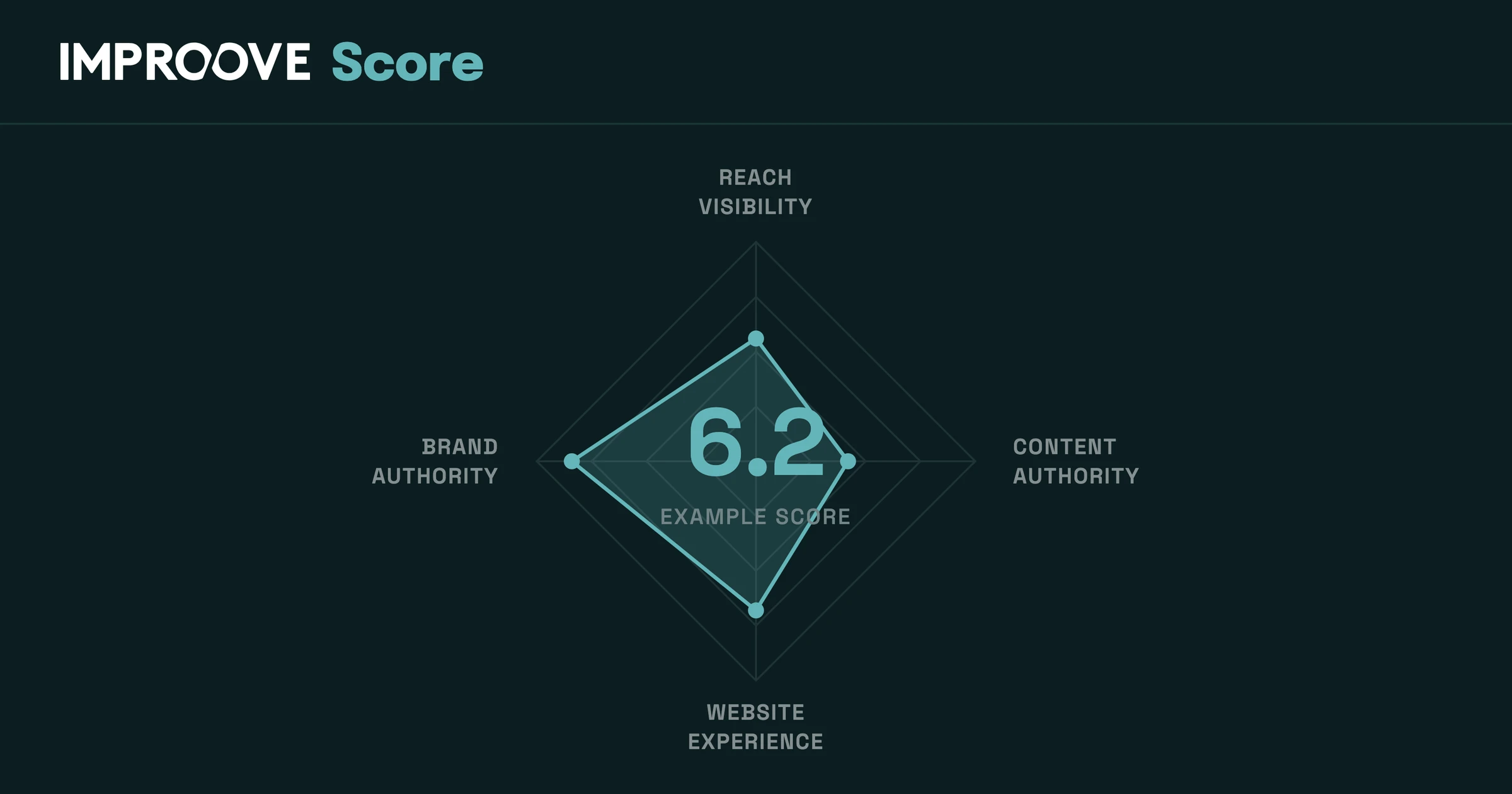
Before we recommend anything to a company, we measure. For years we did it by hand, and every analysis took days: authority, visibility, technical performance, content and, increasingly, presence in AI answers. With the Improove Score, we have automated this diagnosis and are making it available to every business: you enter your domain, and optionally that of your main competitor, and you receive an SEO and GEO score from 0 to 10 by email, along with the details for each factor and the three priorities you should start with.
The key points up front
- The score rates your visibility on Google and on AI platforms in a single model: four dimensions, each with its own KPIs and its own score.
- The analysis is done from the outside: you don't need to grant access to Analytics, Search Console or any other account.
- Instead of a long list of errors, each factor is weighted by its impact on your business, and the report ends with three clear priorities.
Why an SEO and GEO score
People looking for a provider or a product no longer search only on Google. Many also ask ChatGPT, Gemini or Perplexity, and within Google itself, AI-generated answers (AI Overviews) now take up part of the space that used to belong to the organic results.
That doesn't make SEO obsolete. GEO builds on it: what a search engine can't crawl and understand, no AI can recommend. Google confirms this in its own guide to AI search, and on the websites we manage, SEO is still by far the largest source of organic business. At the same time, the new channel is growing fast: on the websites we manage, transactions from generative AI platforms grew by 387% over the last 12 months. That's why the score doesn't measure "SEO or GEO", but both together.
*Source: Google Search Central, Optimizing your website for generative AI features on Google Search (last updated July 10, 2026).*
What the score measures: four dimensions
These are the KPIs you'll find in the report. If there isn't enough data on a website for a KPI, the report shows "N/A" instead of a made-up value.
1. Brand Authority
| KPI | What it measures |
|---|---|
| AI Visibility | How often your brand appears in answers from AI platforms. |
| AI Overview Presence | Whether Google shows you in its AI Overviews. |
| Authority Score | How strong your domain is compared with other websites, based on its link profile. |
Why it matters: without authority, neither Google nor AI has a reason to recommend you over your competitors.
2. Reach & Visibility
| KPI | What it measures |
|---|---|
| Visibility index (year over year) | How your visibility in search engines has developed compared with the previous year. |
| Organic traffic (year over year) | Organic traffic in the last quarter compared with the same quarter of the previous year. |
| Traffic concentration | Whether your traffic depends on a handful of pages, and how risky that is. |
| Keywords in the top 10 | How many keywords you rank for on the first page of results. |
Why it matters: the year-over-year comparison separates the real trend from seasonal swings and flags a drop early.
3. Website Experience
| KPI | What it measures |
|---|---|
| LCP | How quickly the main content of your key pages loads. |
| CLS | Whether elements shift around while the page loads. |
| INP | How quickly the website responds to clicks and input. |
| Accessibility | Whether everyone can use the website, including people with disabilities. In the EU, this is also a legal requirement in many industries. |
Why it matters: this is the technical foundation. Without it, neither people nor search engines nor AI models can make good use of your website.
4. Content & Authority
| KPI | What it measures |
|---|---|
| Duplicate content | The same or very similar text on several URLs, which leaves search engines unsure which page to show. |
| Duplicate titles, H1s and meta descriptions | Different pages with the same title, H1 or meta description. |
| Thin content | Pages with so little content that they offer nothing to users or search engines. |
Why it matters: unique, complete content is the minimum requirement for search engines and AI to use it as a source.
How the score is calculated
Each KPI gets its own value and its own weight, depending on its impact on your business: a duplicate title carries less weight than losing a third of your organic traffic in a year. The values are first combined per dimension and then into an overall score from 0 to 10. In the report, each dimension is flagged as a critical area, an area for improvement or a strength.
How to read the overall score
| Score | What it means |
|---|---|
| Below 5 | Urgent action needed: the website is leaving opportunities on the table. |
| 5 or higher | The foundation is in place. The question is where the potential lies and what to tackle first. |
What you get
- The overall score and the scores for all four dimensions, shown as a radar chart.
- The critical KPIs, with their value and an assessment.
- Three priorities: the areas where targeted action will improve your score the most.
- A comparison with your competitor, KPI by KPI, if you add one.
- By email in about 15 minutes, or about 30 minutes if you add a competitor.
- For your market: Germany, Austria, Spain, the US, the UK, France, Italy or the Dominican Republic.
Be among the first to try the Improove Score
The Improove Score launches in the next few days, free and with no strings attached. Follow us on LinkedIn and we'll let you know on launch day.
Follow Improove on LinkedInWhat the score doesn't do
To set the right expectations: the score is a snapshot based on external data, not an audit. It doesn't analyze internal business data, it doesn't check what AI answers say about you or how often you're cited as a source, and it's no substitute for a tailored SEO and GEO strategy. It shows you where you stand and where to look first.
Where the method comes from
The model behind the score was developed by David Terrón Sánchez, Head of SEO/GEO at Improove: which KPIs go into it, how they are spread across the four dimensions and how much weight each one carries. It's the same method he uses every day in our clients' SEO and GEO strategies. Juan López, Head of Analytics & AI and former Head of SEO at lastminute.com, built the data and automation layer that turns days of analysis into minutes. Before launch, we tested the score on real websites from a range of industries and markets.
What we already achieve for our clients
- +387% transactions from generative AI platforms
- 6.5x visits from AI platforms, with growth on every single website
*Aggregated, anonymized data from the websites and markets we manage: October 13, 2025 to October 12, 2026, compared with the previous 12 months.*
Frequently asked questions about the Improove Score
Do I need to give access to Google Analytics or Search Console?
No. The analysis is done from the outside; all we need is your domain.
Why is it free?
Because every good decision starts with knowing where you stand. If the report shows clear opportunities, we're happy to help you make the most of them. But the decision is always yours.
Does it replace a full SEO and GEO audit?
No. The score shows you where you stand and where to start. An audit goes deeper and takes your business model, your content and your internal data into account.
What happens if there isn't enough data on my website for a KPI?
That KPI shows up as "N/A" in the report. We don't make up a value.
How long does it take?
About 15 minutes, or about 30 if you add a competitor. You'll receive the report by email, so you can close the page in the meantime.
How Improove can help
The score is the first step. If you want to go further, start with the AI Search Audit: we analyze your visibility in ChatGPT, Perplexity, Gemini, Copilot and AI Overviews, benchmark you against your competitors and deliver a prioritized action plan. Both are part of our SEO/GEO management.
Where does your website stand in AI search?
In a free initial consultation, we look together at where you should start with SEO and GEO.
Free initial consultation