If you want to know how a company is perceived today, you increasingly don't ask Google — you ask ChatGPT, Perplexity, Gemini, or the AI overview in search. And these systems answer differently. Not a set of ten blue links you piece into your own picture. One answer. A single, synthesised, seemingly objective answer — and behind the scenes, the system decides which brands it names, in what context, and with which facts.
That shifts the central question in marketing. It's no longer just "Are we ranking for our keywords?" but: does AI even recognise our brand as what we are — consistently, correctly, and across every source? This is exactly where Brand Entity Management comes in. It's one of the most underrated levers in Generative Engine Optimization (GEO), and one of the few you can actually master through discipline and governance.
The key points upfront
- AI systems don't recognise brands by name alone, but through consistent facts, messaging, and connections across every source.
- Entity consistency is the baseline requirement for GEO visibility. If your sources contradict each other, AI can't build a clear picture of your brand — and cites you less often, or not at all.
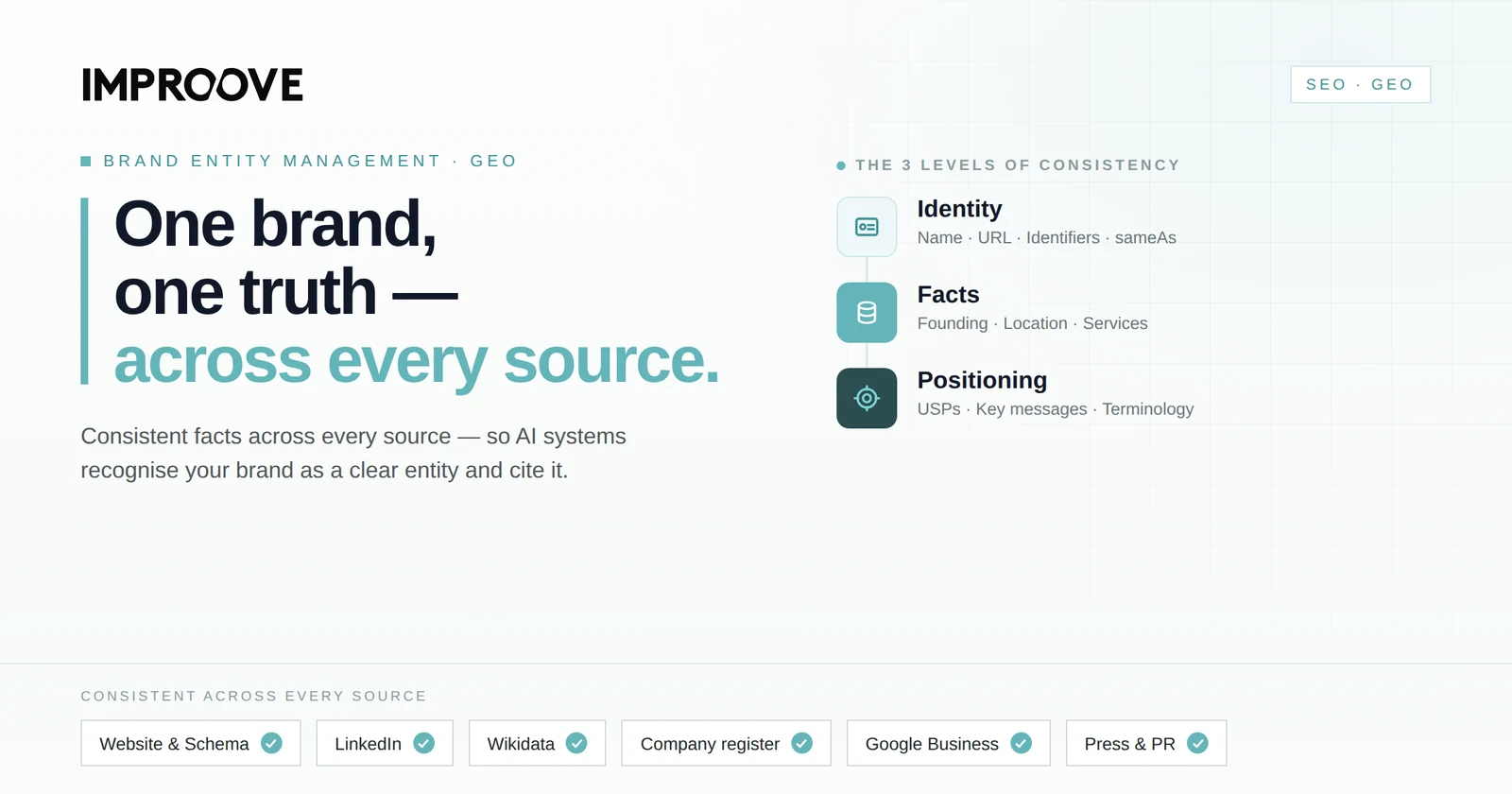
- Consistency has three layers: identity (name, URL, identifiers, sameAs), facts (founding, location, services), and positioning (USPs, terminology).
- For larger companies, this is a governance issue, not a one-off SEO task — central ownership plus binding briefings for everyone who talks about the brand.
- It's the cheapest GEO lever with the biggest payoff: you don't produce new content, you bring what already exists into alignment.
What Brand Entity Management means in a GEO context
AI systems don't think in pages, they think in entities. An entity is a uniquely identifiable thing — a company, a person, a product, a place — with attributes and relationships to other entities. When a language model talks about your company, it doesn't pull up "your website." It draws on an internal picture of that entity, assembled from many sources.
Brand Entity Management is the discipline of deliberately shaping that picture: making sure your brand's name, facts, positioning, and connections say the same thing across every source. It's the logical evolution of what classic SEO calls "entity optimisation" and Local SEO calls "NAP consistency" — with one crucial difference in the consequences. In a classic search index, an inconsistency costs you ranking points. In a generative system, it can mean AI never builds a coherent picture of your brand as an entity in the first place — and you simply don't show up in the answer. We covered why this hits especially hard for local visibility in Local SEO in LLMs.
Why AI systems depend on consistency
Language models build their knowledge of a brand from statistical patterns across a huge number of sources. The more often the same facts appear in the same form, the more stable that entity's representation becomes. If sources contradict each other — "GmbH" here, "Group" there, 250 employees here, 800 there, "industrial consulting" here, "software provider" there — the result isn't a signal, it's noise. The system then picks a variant arbitrarily, hedges its language, or drops the brand altogether because a better-supported alternative is available.
The most widely cited GEO foundational study to date supports this logic empirically. Aggarwal et al., in their paper "GEO: Generative Engine Optimization" published at ACM SIGKDD 2024, showed that a source's visibility in generative answers can be significantly increased when content becomes more citable: citations boosted position-weighted visibility by around 40 percent, solid statistics by about 30 percent, and clean source citing by around 27 percent. Classic keyword stuffing, by contrast, brought no measurable benefit.
Important context: the study measures these effects at the content level, not the brand-entity level — so it shouldn't be over-interpreted. But the direction is clear, and highly relevant to Brand Entity Management: generative systems reward substantiation, clarity, and consistency, not keyword repetition. A brand whose facts show up consistently and verifiably everywhere is exactly that to AI: substantiated and clear. A brand with contradictory information isn't. We show how to make content specifically citable in Answer-First Content.
Do you know how consistently your brand shows up in AI search?
An AI Search Audit shows you, based on your own data, how often and how accurately ChatGPT, Gemini and Perplexity talk about your brand — and where entity inconsistencies are costing you visibility.
Explore the AI Search AuditThe three layers of entity consistency
In practice, it pays to treat brand consistency not as one big task, but to break it down into three layers. They build on each other and have different error tolerances.
The first layer is identity: your official brand name and its permitted spelling variants, your primary URL, unique identifiers (company registration number, LEI, Wikidata Q-ID if applicable), and the sameAs links that explicitly mark your official profiles as "the same company." Here, error tolerance is zero. If you waver at this layer, you undermine every signal built on top of it.
The second layer is facts: founding year, headquarters and locations, headcount (in bands), legal form, service and product areas, industry classification. These details change — and that's exactly why they go stale in many places at once. The classic breeding ground for inconsistency.
The third layer is positioning: core messaging, your own vocabulary for services and categories, your USPs. This is less about "right or wrong" than about coherence. If the same service is described with different terms depending on region, product line, or agency, AI can't form a clear category mapping — and you won't show up for the queries that matter.
Where consistency matters most: prioritising for larger organisations
Not every source carries equal weight. For a company with limited resources — and that's every company — prioritisation determines the return.
It starts with your website as the canonical source, including all subdomains and regional variants. This is where you define the truth about your brand, ideally machine-readable through structured data (Organization schema with name, url, sameAs, identifier). If your own website is internally contradictory, everything else is wasted effort.
Next come the heavily trafficked third-party profiles: Google Business Profile, LinkedIn, and — not to be underestimated — industry directories relevant to your market and region. For companies operating in specific local markets, this also includes official business registers and local directories that international GEO guides simply overlook. These local, authoritative sources are often more decisive for your fact base than any international portal.
The next tier is curated knowledge sources: Wikipedia and Wikidata (where relevance criteria are met), and, depending on context, Crunchbase. These sources are disproportionately influential for language models because they're structured, linked, and widely referenced. A clean Wikidata entry is one of the most efficient entity anchors there is.
Last comes earned media: press releases, trade articles, analyst reports. These don't just supply facts — they supply the language your brand gets framed in, exactly the material generative systems draw on to derive positioning.
Common inconsistencies in large organisations
The most frequent problems rarely stem from carelessness — they stem from structure. Large organisations divide labour, and entity consistency is a cross-functional issue that often falls under nobody's sole ownership.
Different legal names across touchpoints are typical: the parent brand on the website, the operating GmbH on LinkedIn, a legacy name in directories left over from a merger. Just as common are outdated facts in third-party sources: location and headcount figures long since updated on your own site, but frozen in portals for years. And third, incoherent positioning across product lines and regions, where the same service gets described with five different terms in five markets. For people, that's forgivable. For a system trying to reconstruct a single entity from these signals, it's the central problem. We broke down what happens when this picture tips over and AI starts ignoring you in When AI Ignores You.
A practical five-step playbook
Brand Entity Management becomes manageable once you run it as a repeatable process rather than a one-off project.
- Build a reference list (single source of truth). Define your binding target values: exact legal name and permitted spelling variants, primary URL, identifiers, core facts, and a tight, binding vocabulary for services and core messaging. This document is the foundation for everything else and needs an owner.
- Audit your touchpoints. Systematically capture what's currently stated where about your brand: website and subdomains, structured data, Google Business Profile, LinkedIn, business registers, directories, central PR channels. The result is a gap list: target vs. actual.
- Prioritise the gaps. Work through the layers in order — identity first, then facts, then positioning. A wrong name in an authoritative source is more urgent than an inconsistent claim.
- Synchronise. Bring every source in line with your target values — directly wherever you have access, through correction processes for third-party sources. Anchor identity additionally at the technical level through sameAs links and consistent structured data.
- Turn it into a routine. Set up a quarterly review-and-update cycle with clear ownership. Entities drift after rebrands, acquisitions, relocations, headcount growth. And what you don't measure, you can't manage: we've covered which GEO KPIs are worth tracking separately. Consistency isn't a state, it's an operating mode.
Get your brand entity in order before you invest in visibility
In a free initial consultation, we'll look at where your brand is drifting apart across your website, directories and AI systems — and which steps to tackle first.
Book a Free Consultation!The real challenge is governance, not technology
The reason Brand Entity Management fails in larger companies is rarely technical. Setting up schema markup or correcting a LinkedIn profile is easy. What's hard is telling the same truth consistently across an organisation with decentralised marketing teams, multiple country entities, external agencies, and PR partners.
That's why the decisive step is organisational. You need centralised entity governance: a named owner who holds the reference list and is accountable for compliance with it. And you need binding GEO briefings for everyone who talks about the brand: internal content teams as much as agencies and PR partners should receive the binding facts, permitted spellings, and core vocabulary as a requirement, not a recommendation. That's what makes consistency scalable instead of something that breaks apart at the next reorganisation.
This governance character is exactly what makes entity management attractive for larger organisations: it's one of the few GEO levers that doesn't depend on algorithm whims, but on discipline. And discipline can be built. We explore why SEO and GEO belong together rather than compete, looking at the Austrian market, in SEO and GEO in Austria.
Conclusion: the cheapest GEO lever with the biggest payoff
While many companies are currently investing in elaborate content programmes to appear in generative answers, one basic requirement often goes unaddressed: whether AI even knows who you are. Brand consistency is cheap by comparison — the work is stocktaking, cleanup, and routine, not producing new content. And its impact is fundamental, because it's the foundation every other GEO signal ultimately rests on.
The pragmatic recommendation, then: before you invest in visibility, secure recognisability. A structured entity audit shows within a few days where your brand is drifting apart across the sources that matter — turning a diffuse risk into an actionable list.
How consistently does your brand currently show up across your website, directories, and AI systems? That's exactly what we check in the AI Search Audit, and we support the ongoing work through Managed SEO & GEO. Get in touch about an entity audit.