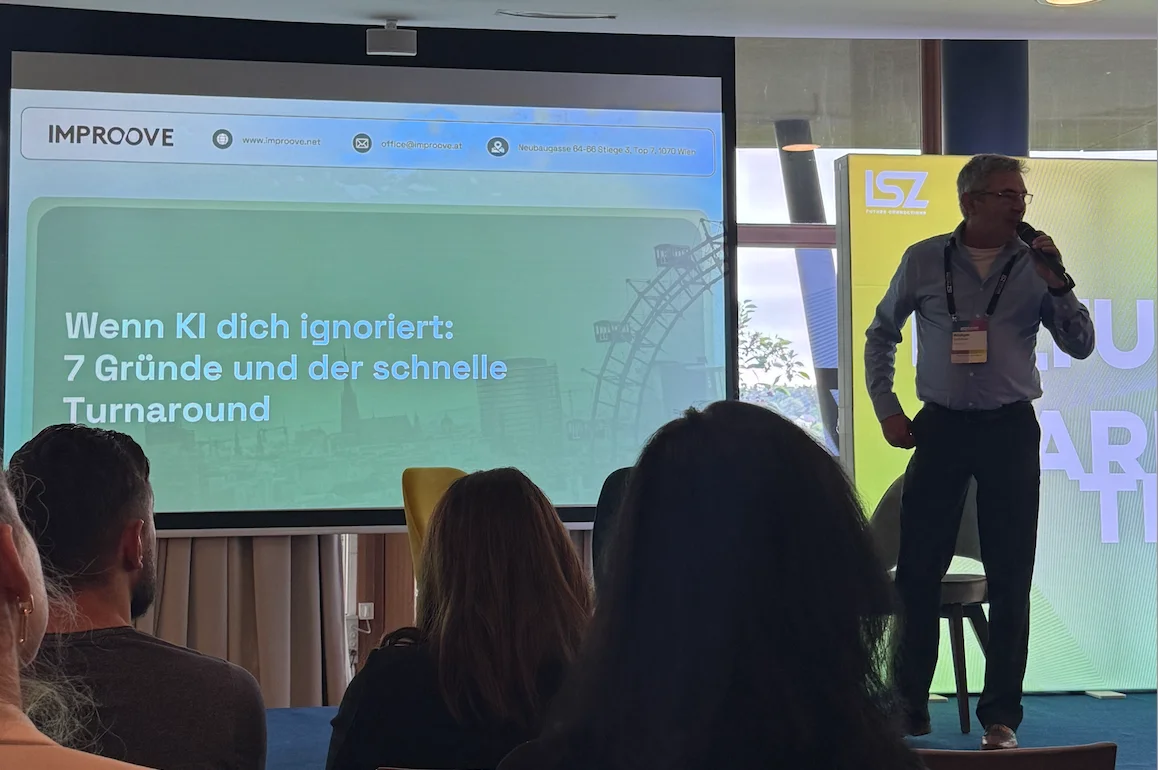
At LSZ's Future of Marketing, we delivered this keynote live for the first time. The audience reaction made one thing clear: most companies sense that search behaviour is fundamentally changing. But they don't know why their brand simply doesn't appear in AI responses.
AI systems like ChatGPT, Perplexity or Google AI Overviews are now a decision-making layer. Anyone not present there loses potential customers before they have even clicked. In this article, we explain what causes this and what you can do about it.
The Key Points Up Front
- AI compresses many sources into a single answer. Website, blog, PR, cases, reviews: only what is clear, citable and verifiable survives this filter. Campaign language is ignored.
- Buying decisions happen before the click. Previously: ranking, click, conversion. Today, AI decides who it recommends before anyone has landed on a link. Anyone absent at this stage is out of the process.
- The problem is not "no content" — it's "not citable". Many brands have plenty of content. But unclear brand identity, missing evidence and generic texts mean AI classifies you as advertising, not as a source.
The Hard Truth First
An Austrian brand, eight years on the market, a six-figure marketing budget: zero out of thirty relevant AI test queries include the brand. Not in their core category, not in related topics, nowhere. This is not an isolated case. It is a pattern.
What teams typically measure: rankings, CTR, sessions. What they don't see: whether their brand is even on the shortlist before decisions are made. AI responses are not new SERP gimmicks. They are briefings for decision-makers.
What Has Really Changed
Classic SEO followed a clear pattern: ranking, click, traffic, conversion. Today the sequence looks different. AI mentions your brand. AI cites your content as a source. The purchasing decision happens before the click.
The key point: AI compresses everything that exists about your brand into a single answer. Website, blog, PR, cases, social, partners, reviews. What remains after this compression process is only what is clearly formulated, unambiguously attributable and externally confirmed.
Ready for the Turnaround?
We analyse your SEO foundation and show you in a free initial consultation which three measures will have the greatest impact.
Gratis Erstgespräch!The 7 Reasons in Two Clusters
The causes of missing AI visibility can be traced back to seven structural problems, grouped into two areas.
Cluster A: Identity and Content
1. Entity Ambiguity
Name variants, sub-brands, different spellings across channels: This sounds like a detail, but it is fatal. AI cannot reliably grasp a brand as a distinct entity when the signals are contradictory. What cannot be clearly attributed is not cited.
2. No Groundable Reference Anchor
There is no clear, central source that genuinely answers: Who are you? What do you do? For whom? Since when? With what verifiable results? Without this "Single Source of Truth", brand identity remains fragmented online and therefore difficult for AI systems to grasp.
3. Non-Citable Content
Campaign language works as advertising, not as a source. AI draws on content that concretely answers questions: definitions, comparisons, steps, classifications. If these formats are missing, there is nothing to cite.
4. Proof Gap
"We are leading in our field" is an opinion. With concrete cases, traceable methodology and verifiable figures it becomes a citable source. Claims without evidence are not treated as proof by AI systems.
Cluster B: Architecture and Validation
5. Weak Trust Network
AI does not trust a brand because it points to its own competence. It trusts it because others confirm it: partners, associations, press, reviews. If these external signals are missing, the trust signal is simply not strong enough.
6. Fragmented Knowledge Architecture
Knowledge distributed across many pages, thematically contradictory and poorly internally linked, overwhelms not only human readers. AI systems lose the thread when no clear hub-cluster system exists that builds topical authority.
7. No Feedback Loop
Anyone who measures only traffic and rankings does not know whether they appear in AI responses, whether they are cited as a source, or which topics are still missing. Without this directional measurement, there is no meaningful way to steer.
The 3 Levers You Can Control
All seven reasons can be traced back to three concrete levers.
Entity Clarity means defining your brand in a machine-readable way: consistent spelling across all channels, real authors with visible profiles and credentials, a central reference page with identity, expertise and proof.
Answer Assets are content that AI likes to cite. Each core topic needs at least one clear definition, a comparison with trade-offs and a proof asset with verifiable figures. The goal is decision content, not awareness content.
Proof & Trust Network is the external validation of your competence: cases and studies, partners and associations, press and podcast appearances, speaker presence at events, reviews and profiles on relevant platforms. Trust is built outside your website and anchored internally.
This is not an SEO project. It is a brand-led content and proof system. And it is the difference between a brand that gets cited and one that gets ignored.
The 30-Day Turnaround
Anyone who wants to start immediately can proceed in a structured way with this four-week plan. Important: the goal is not more content, but better anchored content.
Week 1: Diagnosis. Define thirty typical buyer questions from your category. For each one, check: who does AI mention? Which sources dominate? Where is your brand missing?
Week 2: Clarity. Build a groundable reference anchor. Consistently prepare identity, expertise and proof. Internally link hub to topics to proof.
Week 3: Answer Assets. Produce one definition, one comparison and one proof asset per core topic. Plain language, no marketing speak.
Week 4: Trust Push. Activate five to ten external confirmations: profiles, partners, associations, PR placements. Trust is built externally.
How Success Becomes Measurable
The relevant KPIs for AI visibility differ from classic SEO metrics.
The Share of Mentions measures how many of the defined test queries mention your brand, monthly, under identical conditions. The Share of Citations goes a step further: is your content actively cited as a source or merely mentioned? Coverage captures how many buyer questions already have citable assets across TOFU, MOFU and BOFU. The Proof & Trust Index assesses whether external confirmations are visible, findable and growing.
A practical example: a brand that started with zero out of thirty test queries reached eleven out of thirty within thirty days using these measures and was cited directly as a source three times. No trick, no tool. A system.
How Improove Can Help
With our GEO Management we don't start with campaigns. We first analyse how AI systems currently perceive your brand, where structural gaps in identity, content and trust network exist, and which levers make the biggest difference.
Those looking for a quick entry point will find with the SEO/GEO Check an honest assessment: how visible are you today in AI responses, and what specifically needs to change?
Appearing in AI responses is not a hack. It is the result of clear identity, citable knowledge and verifiable proof.