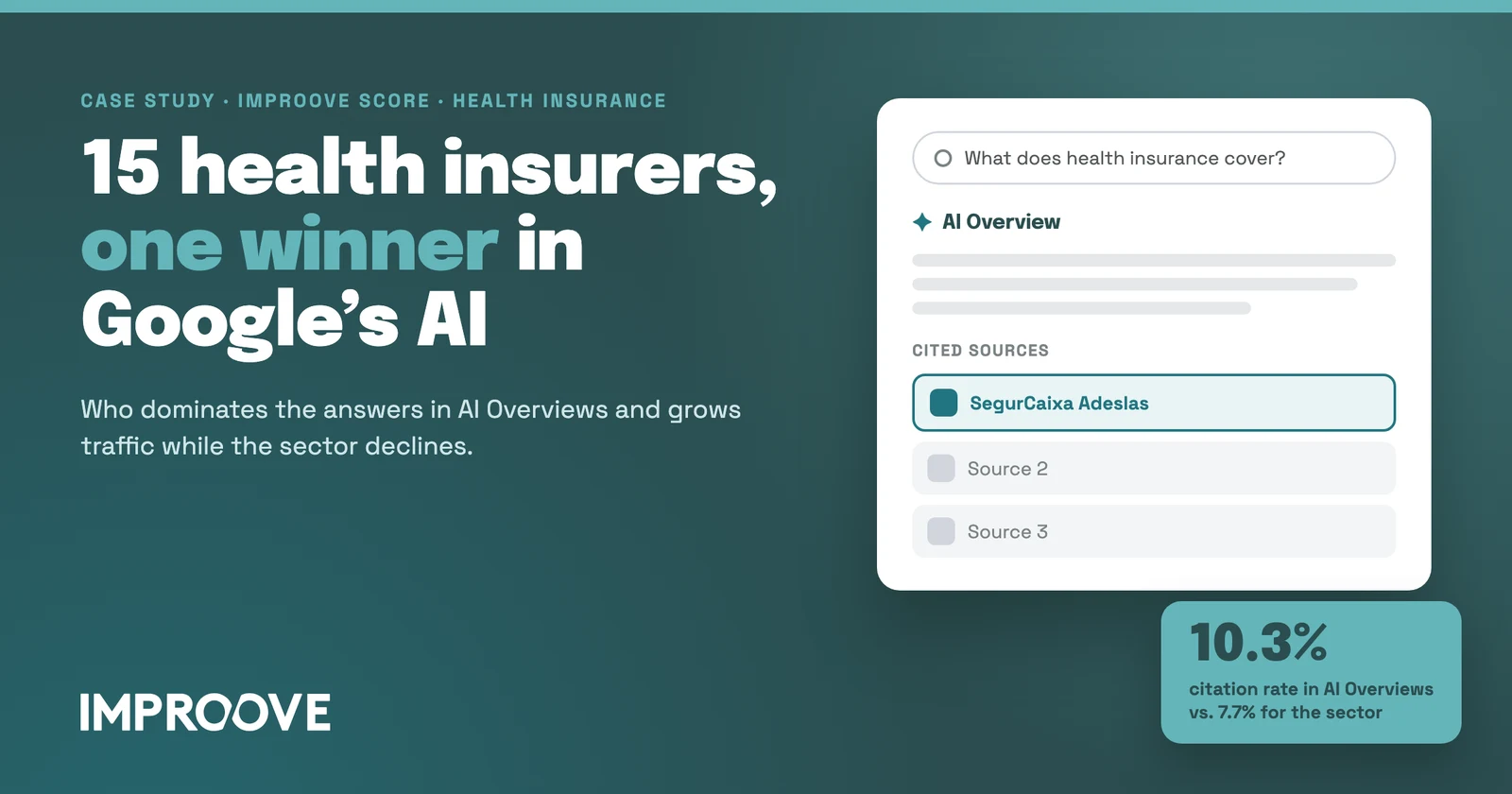
When someone searches Google for what a health insurance policy covers or how much it costs, the first thing they see is increasingly not a list of links but an AI Overview: a summary that Google's AI generates at the top of the results to answer the question directly, linking to only a handful of websites as sources. If your insurance company isn't among them, you're at a disadvantage before the user has even seen the results. That's why ranking alone is no longer enough in SEO: you also need AI to cite you.
Who is winning that battle in the health sector? To find out, our team at Improove in Madrid compared SegurCaixa Adeslas, one of our clients, with 14 of the health insurers it competes with in Spain. We didn't stop at the usual traffic and rankings: we also measured how often Google's AI cites them, how their visibility is developing and what experience their websites offer.
To do this, we used the Improove Score, the new GEO/SEO analysis tool we have developed at Improove. With data from October 2026, the conclusion is clear: SegurCaixa Adeslas is ahead of the sector precisely where visibility is decided today. Before we get to the results, here's a quick look at how it works.
A quick explanation of the Improove Score
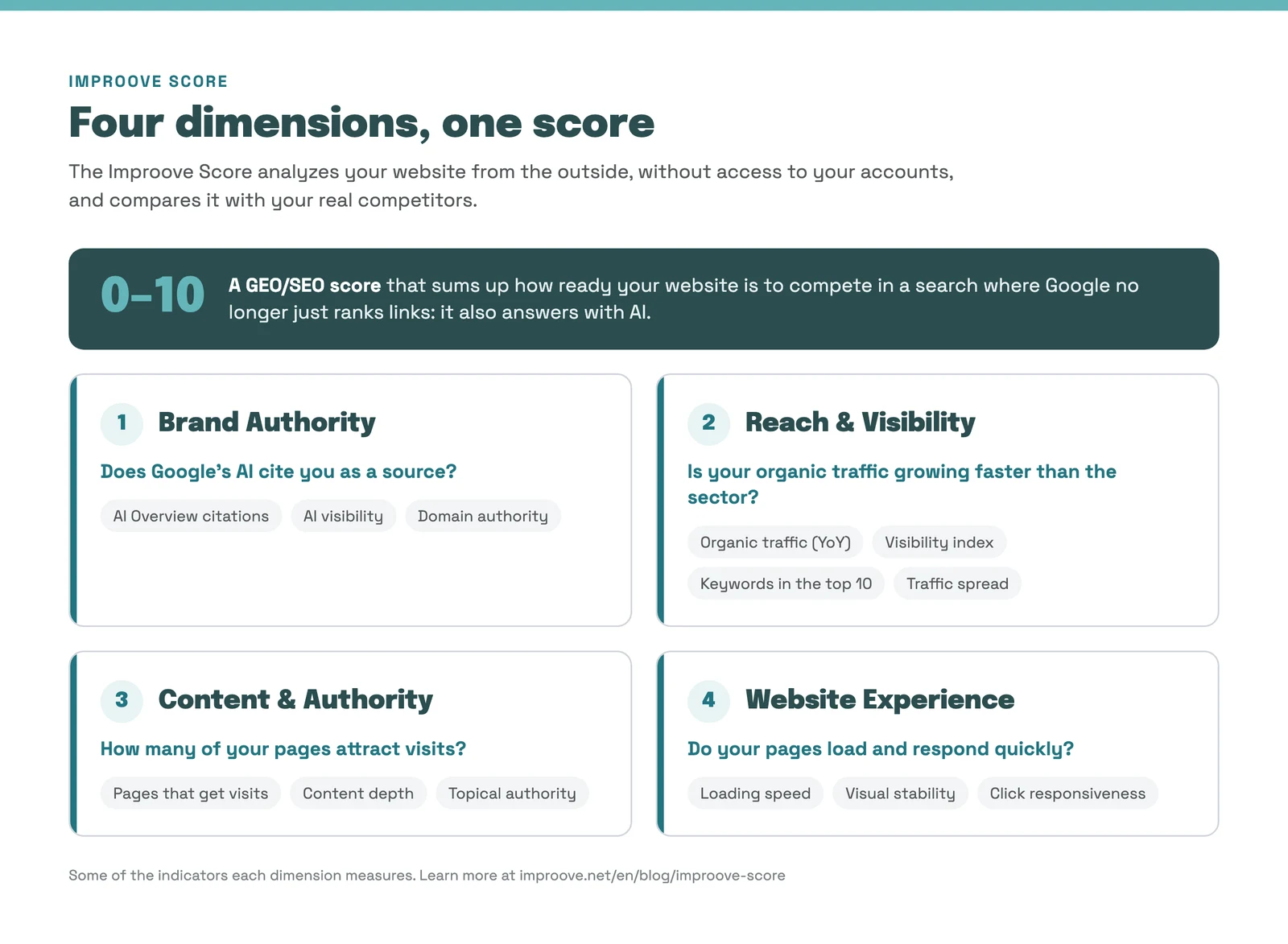
The Improove Score is a rating from 0 to 10 that sums up in a single number how well prepared a website is to compete in today's search, where Google no longer just ranks links but also answers with AI. It brings classic SEO and GEO, meaning optimization so that AI picks you as a source, together in one analysis.
It's calculated from the outside, without access to your accounts or your analytics, and always in comparison with your real competitors. It evaluates four dimensions:
- Brand Authority: whether Google's AI cites you as a source and how much authority your domain has.
- Reach & Visibility: how your organic traffic and rankings are developing compared with the sector.
- Content & Authority: how many of your pages attract visits and how much topical depth and authority they have.
- Website Experience: how your pages load and respond for real users.
The result is a clear picture of where you stand against your competitors, what your gap is and where to start. This is the first sector case study we have published with the Improove Score.
SegurCaixa Adeslas's results at a glance
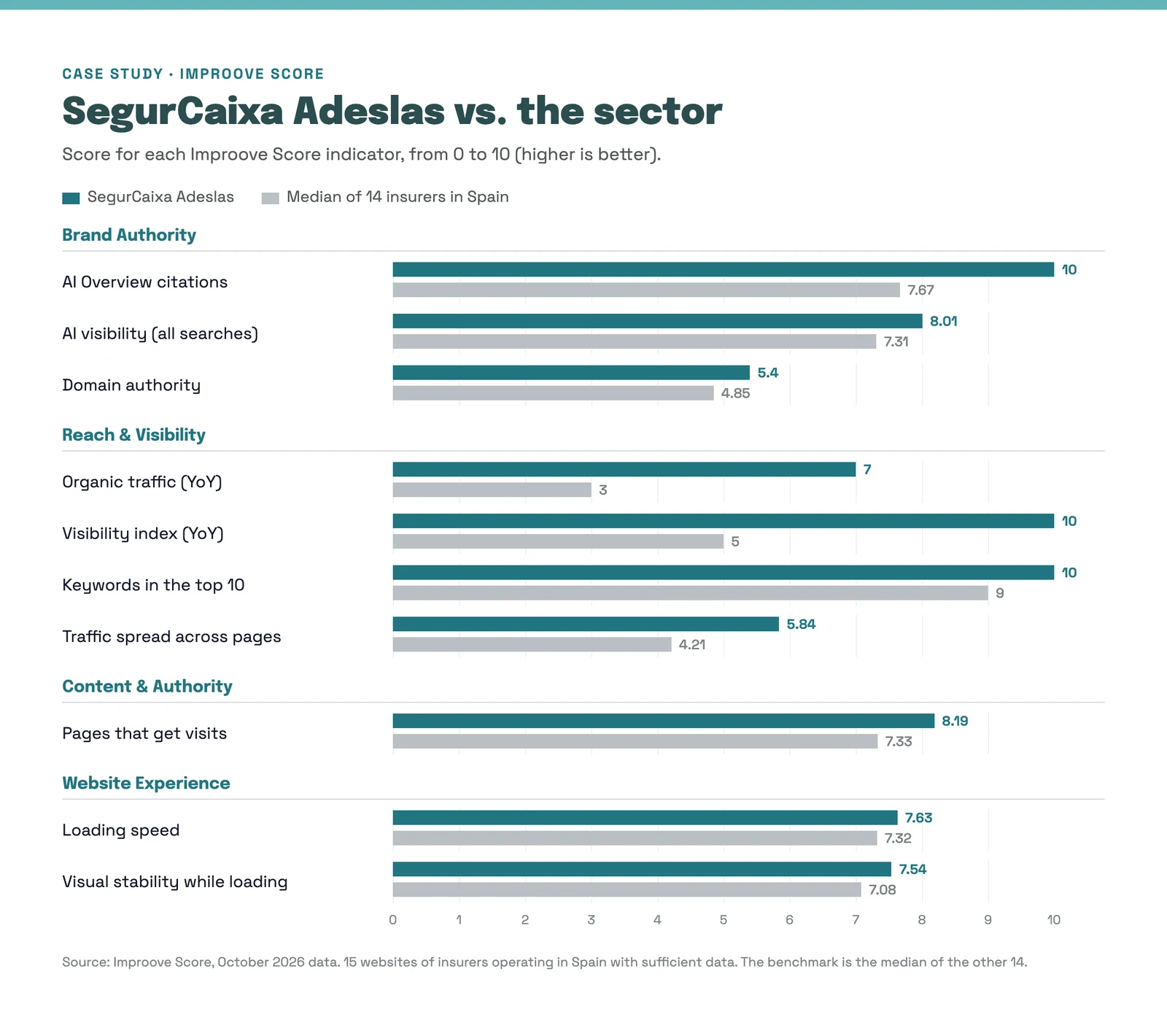
- Citations in Google's AI: when Google shows an AI summary for a search in which SegurCaixa Adeslas appears, it cites the company as a source in 10.3% of cases. That's the highest figure of the 15 insurers analyzed; the sector median is 7.7%.
- Organic traffic: up 4.3% in a year, while the sector median fell by 8.3%.
- Speed: only 5% of visits to its key pages load slowly, compared with 8.5% across the sector.
The chart shows the rating the Improove Score gives it for each indicator, compared with the median of the other 14 insurers. It outperforms the sector on every indicator in the chart, and the gap is widest precisely where visibility is decided today: Google's AI and traffic development.
AI Overview citation ranking: the 15 health insurers in Spain
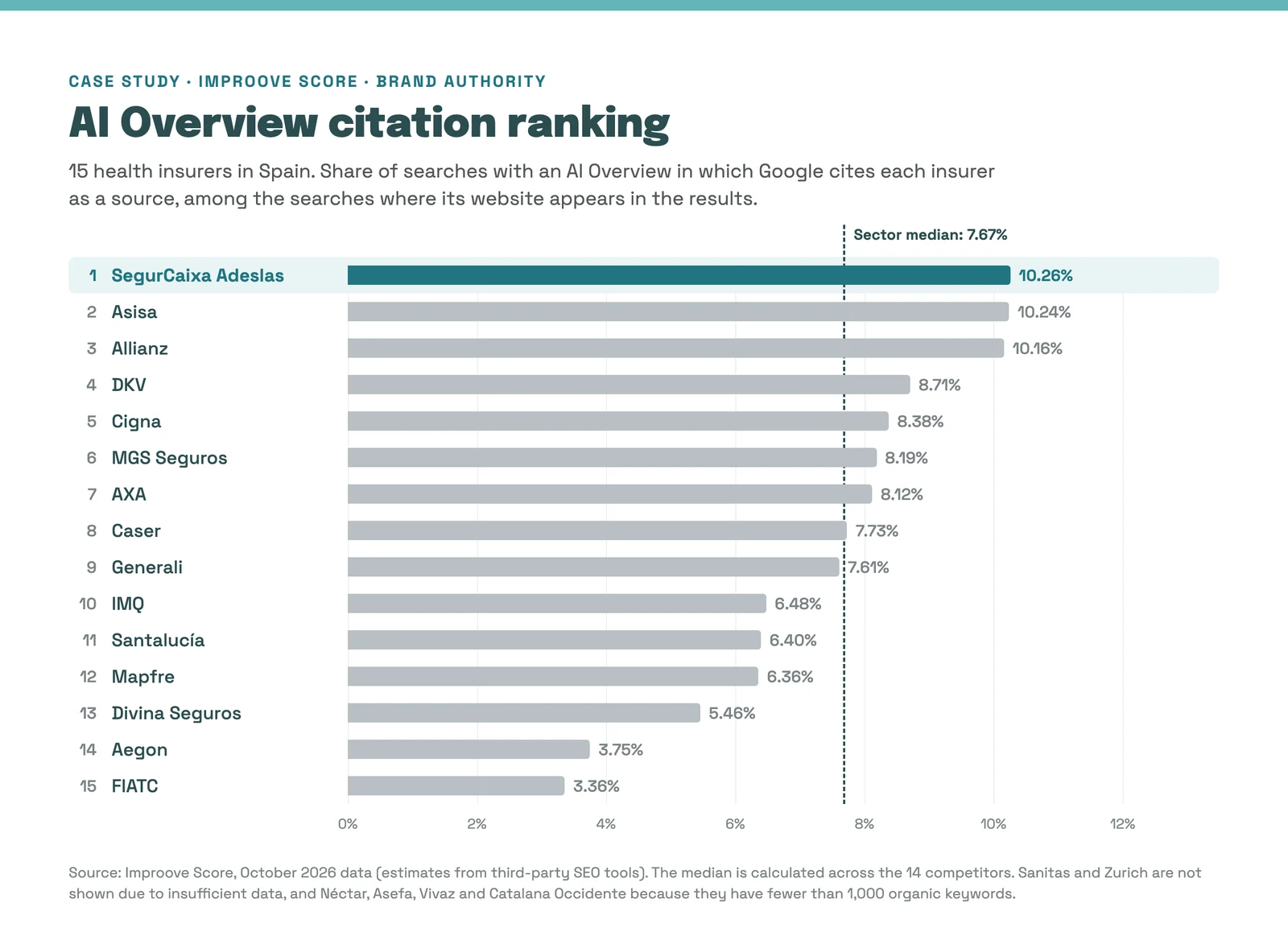
Which insurers does Google's AI cite most? We analyzed the searches in which each insurer appears on Google and that also show an AI summary. Then we counted how many of them cite the insurer as a source. SegurCaixa Adeslas achieves this in 10.26% of cases, more than any other.
1. Brand Authority: being the source Google cites
AI Overview citations: 10.3% compared with 7.7% for the sector. SegurCaixa Adeslas appears in the results of thousands of searches in which Google shows an AI summary. In 1 in 10 of them, the AI cites it as a source. None of the other 14 insurers analyzed achieves this more often, and 12 of them stay below 9%.
Looking at all the searches in which it appears, with or without an AI summary, Google's AI cites it in 5.8% of them. The sector median is 4.8%.
Domain authority: 54 out of 100, the second highest in the sector (the median is 48). Authority is one of the signals Google takes into account when deciding which sources to trust, including when it writes its summaries.
What it means for the business. If AI cites you, you make the user's shortlist before they even start comparing. If it doesn't, they may never see your website in the results at all.
How we work on it at Improove. GEO is built on solid SEO. With our AI search strategy, we identify the questions where AI cites your competitors instead of you. Then we create authoritative, expert-reviewed content to answer them: in health this is essential, because Google treats it as a YMYL topic and demands the highest level of reliability. And we strengthen the brand's authority with media mentions.
2. Reach & Visibility: growing while the sector shrinks
Organic traffic: +4.3% compared with −8.3% for the sector median, comparing the third quarter of 2026 with that of 2025. Over the same period, 8 of the 14 insurers analyzed lost traffic.
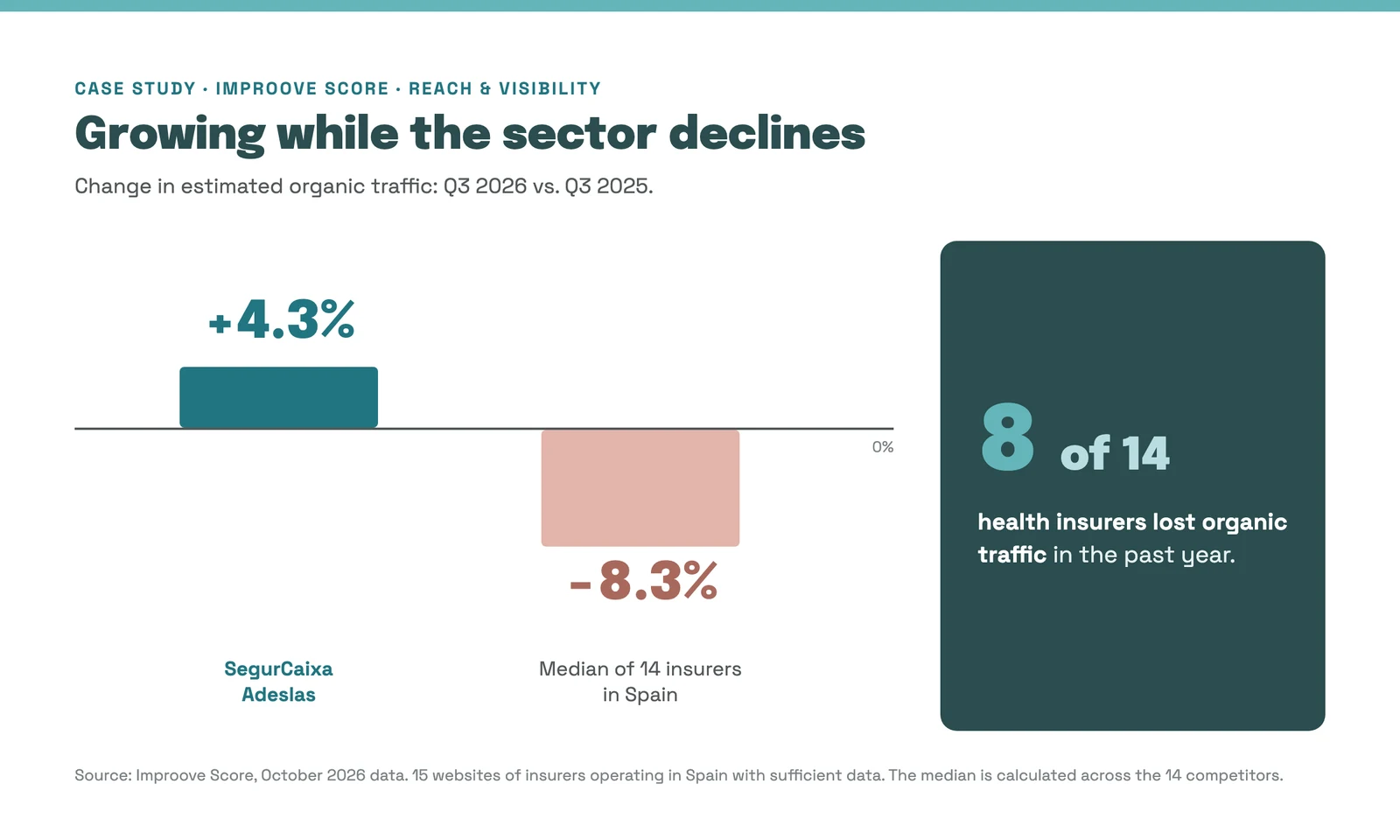
What it means for the business. Now that AI summaries are taking a share of the clicks, simply holding on to organic traffic is an achievement; growing it is the exception. And every visit that comes from Google is a potential customer you don't have to pay for in advertising.
How we work on it at Improove. With a content strategy that answers what people really search for about health insurance, a website architecture that spreads traffic across many pages instead of relying on a few, and monthly monitoring so that priorities are set based on data.
3. Content & Authority: pages that attract visits
Pages that receive visits from Google: 82% compared with 73% for the sector. The SegurCaixa Adeslas website has more than 3,000 pages, and more than 8 in 10 of them attract organic traffic. Only two of the other 14 insurers analyzed have a higher percentage.
What it means for the business. A page nobody visits costs money to maintain and brings in no customers. The more pages that answer real searches, the more entry points the brand has, and the better the chances that Google, and its AI, will find the answer they're looking for there.
How we work on it at Improove. With a content audit that identifies which pages aren't attracting visits and decides whether to improve, merge or remove them. Then we strengthen the pages with the greatest business potential using expert-reviewed content, as a YMYL sector demands.
4. Website Experience: less waiting where the sale is decided
Visits with slow loading: 5% compared with 8.5% for the sector. We measure this with real user data (Core Web Vitals) on its key pages: the homepage, the medical directory and the contact page. In addition, only 6% of visits experience layout shifts while the page loads, compared with 11.5% for the sector.
What it means for the business. On an insurance website, slowness does the most damage exactly where conversions happen: in the medical directory search, the quote calculator and the contact form.
How we work on it at Improove. With a technical SEO audit that identifies what is slowing the website down, a workshop so the development team knows what to change, why and how, and daily monitoring of the pages that generate the most business.
What your insurance company can achieve
12 of the 14 insurers analyzed stay below 9% of citations in AI summaries, and 8 of the 14 lost traffic this year. There's a clear gap, and the insurer that closes it first will become AI's go-to source. Here are four steps to get started:
- Search Google for your 10 best-selling insurance products and note which AI summaries you appear in and who the AI cites when it isn't you.
- Compare your organic traffic for the last quarter with the same quarter last year.
- Check the speed of the pages that convert, across different page types, not just the homepage.
- Request your Improove Score to see all of this against your competitors, backed by data.
Frequently asked questions about SEO/GEO for insurers
How can an insurance company get Google's AI to cite it?
There are no shortcuts: Google's AI picks as sources the websites it trusts most for each question. In health insurance, that means having content that clearly answers what users are looking for (coverage, prices, co-payments, medical directory), written or reviewed by experts and published on an authoritative, technically sound website. This is the work we call GEO (Generative Engine Optimization), and it's built on solid SEO.
Does appearing in AI Overviews take traffic away from my website?
It can take clicks away from the most informational searches, because users find the answer without visiting any website. That's exactly why it's so important to be one of the cited sources: your brand appears in the answer, and the most interested users come through to your website. In our analysis, SegurCaixa Adeslas, the insurer most cited by Google's AI, is also growing its organic traffic while the sector median declines.
Is SEO for insurance companies different from other sectors?
Yes. Health insurance is a YMYL (Your Money or Your Life) topic, meaning it can affect people's health or finances. That's why Google is more demanding: it prioritizes content written by experts, reviewed by professionals and published by authoritative brands (what Google calls E-E-A-T).
How Improove can help
We're a GEO/SEO agency: we work to make your brand visible both on Google and in AI answers. The first step is the Improove Score: it analyzes your website and your competitors' websites on the factors that decide visibility today, and shows you where you stand, what your gap is and where to start.
Where does your insurance company stand in Google's AI?
Request your Improove Score and we'll show you, backed by data, how you compare with your competitors and where to start.
Request my Improove ScoreMethodology
Data from October 2026, obtained with the Improove Score. We compared SegurCaixa Adeslas, a health insurer and Improove client, with 14 other insurers operating in Spain. We started with 20 competitor insurance websites; 6 were excluded because there was not enough data.
As a benchmark, we used the sector median, which isn't distorted by very large or very small websites. AI Overview citations are the percentage of searches with an AI summary, among those in which the website appears in the results, where Google cites it as a source. They measure Google only, not other AI platforms. Organic traffic is an estimate for the third quarter of 2026 compared with that of 2025. Slow loading and layout shifts are the percentage of real visits with a poor experience on the key pages. The chart shows the 0 to 10 rating that the Improove Score assigns to each indicator. The data are estimates obtained with third-party SEO tools. Excluded from the ranking were Sanitas and Zurich, due to insufficient data, and Néctar, Asefa, Vivaz and Catalana Occidente, for having fewer than 1,000 organic keywords.